Tipuric stars as Wales comfortably see of Lelos

Wales and Georgia in a slightly underwhelming game following the Weekends feast of rugby. However, Wales taking advantage of the underdogs tag are starting to build again after perhaps a disappointing warm up series. Fitness severely tested vs Ireland and England with a lack of innovation caused slight worry amongst Welsh fans. 

The eternal pessimism of Welsh Rugby got a bag full of coals for its troubles, Rob Howley being embroiled in an alleged scandal. Unbelievably, for this Wales were seen as stronger with it seen as a restraint being removed. The first half against Georgia standing testament for the work Howley has done, and showing the quality of Tipuric, an all action seven who announced his coming onto the international stage in 2013, v England where Wales scored 30 points.

As you can probably tell, I am inclined to support Howley, he has done wonders but as the Wales team on Monday, I will remove the cloud and get focussed on the game in which Wales exploited Georgian weakness, and kept the pressure on Georgia in the second half while not looking as steady.

Wales strike plays caused Georgia problems throughout the first half

The first try came from a very well worked strike play. The many parts in motion causing problems for the Georgian defence. With Davies line managing to isolate a solitary georgian defender and open a gap  that you could drive a bus through. Another part of this try is that Wales could have scored in some many ways, obviously the strike runners relied on space. But out the back option were numerous with a 2 on 1 almost guaranteed in the wide channels. Yet, this being said as a Welsh fan it was nice to see us score simply rather than try and over complicate the approach.

The strike play attacks have been well documented, a key part of any sides preparation. But it is something we haven’t necessarily seen from Wales with very few moments standing out. With more the role of long possessions to grind the opposition. For example the 30+ phases that put Cory Hill over in Cardiff v England. This Georgia game therefore allowed Wales to really cut loose playing an expansionist game.

However even with a solid base of attack there were some issues with the attack, especially in the second half. Wales were struggling to generate front foot ball and get dominance. However more worrying was the kicking. Especially in the wide channels, with Wales sliding in behind on a number of occasions. This led to a worrying statistic of 9.1% of kicks being regathered. This despite Wales having the best fly half in terms of regathering available. No doubt this was a tactical and game based decision with no need to keep the ball after being 4 tries clear by half time, but it could be a worry.

Yet there were also some gains from this approach, when Wales decided to kick in field Tomos Williams was able to score. 

Tomos Williams arrives to provide solid service.
Tipuric’s hands in the Wide channels proved key on the way to Tomos Williams’ try.

His running from the ruck in the middle of the field resetting from the kick enabled quick service for Dan Biggar. It also meant he was able to adjust and support the next phase, running a so-called ‘cheating line’ to finish the score. But it was made by key man Tipuric in the wide channels with brilliant hands, able to supply the ball rapidly to George North, reminiscent of his play against England in 2013.

By kicking in field North kept the ball alive and enabled both him and Williams to chase.

This then enabled North to run and more importantly time to kick. But instead of continuing with the poor kicks focussed on the sideline he kicked infield. This meant that the ball was alive and Tomos Williams was able to compete having continued his run from the previous ruck in an oddly symmetrical run to the one Gareth Davies used to bury England in 2015. This try showed what Wales can do. The attack out wide supported by outstanding handling from both Tipuric and AWJ.  It shows the kind of threat they can bring should they get it right.

Wales defence was also being bedded in the game. Put under pressure in parts we saw a system common to the 6 Nations being tried out in Japan. One example of this was the shooting scrum half tactic. This tactic obviously has paid dividends before and is a great tool for Wales aggressive defence.

Gareth Davies was able to shoot and apply pressure to Georgias attack.

With Davies positioned slightly wider in the defensive line he increases his time to react. This means that he can also see better when the scrum half is about to play the ball. But while these are benefits the key part is that Davies can block the georgian passing lane. Either forcing them inside to an already organised defence of forwards,in this case Ball and Navidi. Or as happens on this occasion take an intercept, or though this ball hits the ground. This pressure forces teams to make decisions constantly. 

He almost came away with a intercept however, was deemed to have knocked on

However, while the defence was great for the majority of the game at the beginning of the Second Half, they compounded a series of errors to a georgian try, and more worryingly giving away 5 penalties in 12 minutes, 2 in a row alone for the try.

Wales stuttered in the second half, giving Georgia easy position in the first minute.

The first error came directly from the kick off, with Wales slow to react. AWJ claiming the ball back but Georgia were able get players aligned faster with 2 georgian players competing before Wales arrived. The overall reaction seemed was strange for a Wales team, unable to drag themselves up for a half against beaten opposition perhaps.

The welsh maul was exposed twice, leading to them brining it down and conceding in the first minutes of the second half

Then following the kick to the lineout georgia set a menacing maul. The Lelos managing to split 4 welsh players when they split carrying the maul with greater momentum. While not able to finish the final drive a collapse from Navidi and ALun Wyn Jones just built more pressure. It would be interesting to see the result with Adam Beard in the second row, a strong maul defender possibly able to avert such problems. But the general passage just showed the uncharacteristic, lackadaisical defence following the half time break. 

Wales tried t shut down the maul, but gave away a penalty which gave Georgia a subsequent maul from which they scored

Overall the Georgia pressure continued throughout the half, with Georgia finally beginning to exert more pressure. However, it was Wales recovery from momentary lapses which prevented a wide spread come back. For example from these clips around the 59th/60th minute where Wales conceded a relatively soft line break and then force Georgia back before winning a Turnover. It was these moments that really show Wales as contenders whilst some weaknesses perhaps prevent them from being top table favourites.

Georgia also exposed Wales blindside defence

Following a lineout, Wales don’t get any pressure on the Scrum Half with the solitary AWJ working his way towards the 9. This leaves a hole on the short side which georgia expose, with scrum half able to free the blindside winger behind the welsh defence with a lovely offload.

Good linseed from Navidi forced Georgia to rush
The whole backline were able to shut down Japanese options.

However the ever industrious and hard working Wales team get behind the ball and are ready to shoot out the line to shut down georgia at a time usually reserved for drift defence. Te wall of pressure forces Georgia to cut inside, preventing them any real openings. Following this Georgia continue with close carries with Wales on 3 occasions almost holding Georgia up. 

The turning in of Georgian attack enabled Tipuric to secure a turnover
Tipurc was supported by his teammates as he grappled for the turnover

The turnover eventually came when Justin Tpuric managed to get underneath a Georgian carrier and combined with AWJ hold him up. Navidis late addition finally secured the maul and turnover.

This phase of play just showed Wales’ attitude under Shaun Edwards perfectly. The ability to keep working and want to play a physical game paying off as they were rewarded with a turnover. This hard working nature, in my opinion keeps Wales as favourites despite a great temptation to place them as dark horses and relieve more pressure, and default underdogs.

From the game Wales can be happy. The strong attack in the first half proved enough to win whilst protecting themselves from the analysis, that plagued Georgia for those tries. Whilst in the second they stuttered, the job had been done and they were still able to attack fluently at points and create opportunities. One worry will be the surrendering of kicks with only 9.1% regained. But for Georgia the signs could be worse, yet are not brilliant. They lacked threat when attacking scoring at a rate of only 12.5% in Wales half with 0.3 points per opportunity a ⅓ of Wales but overall a solid performance against a Tier One nation.
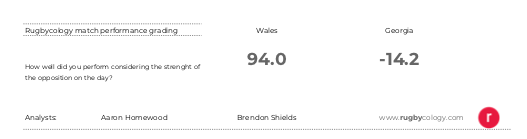
The Rugbycology match rating shows how Wales prevailed while Georgia struggled to match the intensity.

England do enough to defeat physical Tonga

England and Tonga shared a physical battle one that finished off the weekend well and tonga proved staunch opposition in England’s first game. From the games beginning Tonga and England brought full blooded ferocity with close quarters being the theme of the opening salvoes.

Whilst lacking the open play skills of Fiji, Tonga brought a physicality that England on occasion struggled to cope with. However, while the result was never really in doubt it was of benefit for England able to get players up to World Cup intensity in a game unlikely to derail them to the extent of 2015. 

It was clear that Eddie was ready for this first game, his four years of preparations finally put in place as he began to finally build his masterpiece. His preferred midfieldback, using the talent of George Ford, the aggressive Farrell and the baulking Tuilagi. While the back line has gone through many iterations, it has come together in time for the world cup.

But whilst the backline usually are the media’s focus, it has been the forwards where England have struggled,  unable to get a true sevensicne 2015, Eddie has found his men in Ludlam, Curry and Underhill. The physical nature of these 3 are perfect to see Eddie’s plan.

 In the first minute of the game v Tonga, England brought a physical nature, Underhill and Lawes combine to begin a tackle in which Sinckler gets pinged for not rolling. But the very nature in which England attempted to assert dominance and show their strength is interesting. They attempt to hold up a Tongan player rather than attempting to settle in and let Tonga burn themselves against an English defence. While the outcome is negative, England have set their stall out.

England used double tackling in a confrontational defence

Just a minute later they are at again.. Vunipola the final piece of the back row jigsaw combining with Marler to hold up the Tongan attack. With farrell joining the three of them show the strength of England. It may also however show a slight weakness, as against better teams if they try this tactic they may get pinned in again. Also against dominant carries it is difficult with Vuinopola able to catch the Tongan before he can change his height. A key game in exploiting this was Wales in the Six Nations. While the line speed helps England it can also wear them out. However this picking holes and weaknesses for the sake of it. England were rusty but the strength and solidity of their line with the bedding in of technique was the main aspect of Tonga, not the ability to score 90 points.

The physicality of England hit Tonga behind the Gainline.

In defence England also didn’t switch off. Compared to 38 all draw at Twickenham, England maintained pressure and didn’t let Tonga to get a score. That being said, they will want to sure up their defence, with Tonga able to get out  of their own 50, 50% of the time a Stat which will become higher against teams with stronger carriers, and most importantly kicking games.

The English were rusty, against tonga. The intensity exposed England not apparently ready for a world cup mentality at times. Physically they matched Tonga and bettered them on most occassions but at times they made stupid errors, generally brining the jury against the performance.

One example of this was in the 24th Minute when England gave away a penalty for forming a maul before contact. These sort of basic errors shouldn’t be made by a team of England’s level. THey also seem to completely rely on Billy Vuinopola. Whilst it is not completely unheard of for a team to rely on one player, England change completely when he is unsuccessful.

Billy Vunipola got sent backwards, denting Englands attack

A huge it from Tonga sent Billy crashing back, leaving his support in front and allowing Tonga to compete and shut down England’s attack. More worryingly perhaps was Joe Marlers reaction, rather than dealing with the ruck he stays offside and ha wordswith Tonga rather than approaching the job at hand.

Joe Marler left Sam Underhill to deal with clearing out ruck
England are unable to resource the ruck
England give away penalty after struggling to resource the ruck

Following this England begin to throw the ball around. Farrell and Youngs struggling to focus. Whilst partially down to the urgency caused by the need to quickly remove the ball from a less than secure ruck, you would expect better of Farrell and Yougns given their experience. This lack of calmness when under ferocious pressure may just cause England to waste chances.

At the next ruck England are also slow to resource it. Underhill having already cleared the previous ruck has to attend it again with Tonga getting 3 players in the same space where there is one Kyle Sinckler who has to try and clear up the mess he has received. This careless pla does show a slight crack in England, one perhaps not easy to fix.

Im sorry this post has been incredibly England centric but Tonga offered incredibly litte.THis mainly due to an efficient England. England prevented Tonga so much that Tonga hadn’t started an attack in the England 22 before the 55 minute. They were playing poorly, but offered some opportunities they just couldn’t finish. They did finish with 2 chances in England’s 22, but from the entire game lacked any bite in attack as opposed to they’re passionate defence. Tonga scored only 0.1 points per opportunity showing a need t get stronger, but perhaps more due to England’s stifling than Tonga’s own failings.

Looking forward Tonga will get better, the pool is one full of upsets, with Strong teams throughout so whilst they may sneak a win it seems unlikely but the pure Tongan ferocity led to problems for England. England survived and for all the talk of them looking poor, this seemed to be down to a game against not so great opposition, whilst them also struggling to control some areas of the game. It was still a marker but not perhaps as big as they were expected to put down.

Rugbycology ratings showed England dominance whilst nothing outstanding

Poor Scotland taken apart by Ireland in key game

The second game on Sunday, brought the first home nations into combat. A celtic clash with effects that would be felt by the home nation as well as those back home in Europe. Fighting for most likely top spot, Ireland dominated Ireland in a wet Yokohama International Stadium. 

The overall game from Ireland was simple but ruthless with Scotland being unable to get any progress and implement their own attacking game plan. Ireland stated their intentions early with Iain Henderson making a physically baulking run own the centre of the park. This was followed by a series of pick and gos from Ireland as they set the tone for a physical game that Scotland never quite matched.

A really key element of this dominance was Ireland’s ability to defuse Scottish attacks in the wide channels. The Irish easy flowing to rucks, and competing often winning unrovers. The rucks in the 15m channels for Scotland quickly became a poisoned chalice, with them being unable to support their own players in the wide channels.

This was shown quite early on in the 19th minute, when Ireland were able to disrupt Scottish ball. On this occasion it ended in a Scotland penalty but it really showed Irish superiority. The ruck before the Penalty, Laidlaw wasted time being put under pressure from Stockdale as the ball rolled out. Then the next carry Stander was a menace causing a problem,only to be let down by a teammate who got trapped in the ruck, as it had been a tip on. 

Ireland exposed Scotlands natural strength, by attacking breakdowns in the wide areas.
Laidlaw was put under pressure around the base and reacted slowly early on
Stander almost gained a turnover but was prevented by a slow rolling team mate

However, it also showed Scotlands intent being denied by their own players. Ireland’s ability and desire to keep working to compete over the ball seemed to be the story of the first half. Scotland also looked trapped in a place they couldn’t escape. Stretching Ireland but never breaking them. In the 19th minute their ability to find the edge showed cracks, fully exploited an Irish turnover in 29th. The only difference this competition came off the first ruck.

Aggressive defence in the wide channels from Ireland exposed them to danger, but Lamour quelled it well.
John Barclay over runs and doesn’t adapt quickly enough leaving the ruck open.
Jordan Lamour is able to compete over the ball and beats Watson to the ruck to in a turnover.

The key being that because Van der Flier and Lamour competed on the first ruck they were able to expose Scotland’s lack of support in the wide channels. This is what caused problems for Scotland all day but it was just one symptom of an underwhelming performance. The misread from John Barclay causing the turnover as Scotland looked to take advantage of the break by maitland. However, it opened the opportunity for Lamour to swoop, who not even Hamish Watson could remove. These two examples, 10 minutes apart showed just how wasteful, and off the pace Scotland were.

This surrendering of possession killed the Scottish attack, which became a blunt object with no real finish to take advantage. But there are two teams in a game of rugby, and so despite all Scotland’s failings,it was Ireland’s ability to take advantage that decided the game.

One clear example of this was the Henderson break in the first 5 minutes, leading to the first Irish try. The strong line by the irish lock took advantage of an over fold by Stuart Mcinally and confusion from Grant Gilchrist as he was faced with two Irish options. The weak tackles allow Henderson to carry up to and over the 22 finishing within 5 metres of the scottish line. Quick ball is granted when Sexton and Healy work together and clear the ruck. They use this quick ball to keep it tight. 

A strong carry from Iain Henderson exposes weak shoulders in Scotland Defence
Sexton doesn’t over run the ruck but instead remains ready to clear it out.
Sexton and Can Healy combine to clear ruck.

The well oiled Irish machine now starts to rreally grind scotland up. Murray takes charge with Sexton as chief overseer. The return to systems and the success of 2018 take over. The close carries keep battering at the Scottish door. This pressure leads to an immediate score  as the Scottish forwards are unable to wrap round the corner following a switch in direction, with pace coming from Lamour. This trapped previously floating forwards, and enabled Ireland to barrel after 2 more phases.

Murray had a brilliant performance a true general for the troops,

The organisation and ruthlessness for this try was incredible. Sexton and Murray each workinground each other, with no visible angst or worries. Sexton giving up commands to his partner, and attacking when told. This cohesion from playing over 50 times together clearing showing.

Murray really took charge of the attack controlling the game perfectly from the close quarters, relieving pressure from Sexton. His constant attacks down the blindside gained ground and exposed a scottish weakness, opening wounds. These attacks down the blindside, came mainly off set piece possibly helping to expose a Scottish defence set on pushing and covering the openside.

Murray and Best combine to attack Scotland on the blindside

The attacks down the blindside often relieved pressure and really put scotland under the cosh. In the frame above, Murray kicks ahead and puts Scotland on their own 5m line. Below, Stockdale kicks ahead and regathers to bring Irish possession into the opposition 22. This pressure and forward momentum is reflected in the stats, with Ireland generating forward momentum of 70% more than doubling Scotland’s 30%. 

Stockdale exposed Scotland short side, making massive gains
Stockdale chip ahead maximised ground and kept possession

This also led to Ireland scoring over 35% of the time when in Scotland’s half. This ruthless efficiency was really the main difference between Scotland and Ireland. While Ireland were able to control the game, and make themselves opportunities attacking and defending with ease, Scotland struggled with basics and gave the ball away too much Surrendering 72% of their possession and only forcing follow ons 28% of the time. This puts the performance in context and shows how abysmal they were when even Namibia were keeping more ball than the Scottish.

Overall, ireland should be delighted. They performed strongly attacking Scottish weaknesses and easily winning the game. On the other side Scotland really struggled to do much. The constant mistakes were taken advantage of and while the conditions may not have helped them execute their gameplan, as a Tier One side more has to be expected, rather than a reliance on Russel and Hogg.

Rugbycology Match Rating shows how Ireland took apart Scotland.

Namibia put up strong performance against Italy

While certainly no showcase game, Italy and Namibia shared a great game with Namibia putting up a strong fight. Their defensive strength restricted Italy in the first half to only 3 tries, and they even managed to grab one of their own. This intent while not kept throughout the game, resulted in them scoring 3 tries, almost half as many as in 2015.

Italy, also played incredibly well. The attack functioned well and defence, while not brilliant in terms of some aspects. The game was very broken up with 10 scrums recorded by the 23rd minute. This overall led to a broken game. 

But I shall start at the beginning focussing on Namibia’s first try. A wonderful turnover attack from a worryingly unstable Itallian lineout. The attack let Italy break and using some wonderful skills and support lines score the first try of the game. 

Italian overthrow, gives Namibia perfect turnover ball as Italian forwards are tied up.

The moves starts from the back of a lineout, with a slight overthrow, the Namibian hoker gathers at the back and starts charging forward, really attacking the Itallian line. With Italy hoping to form for a maul a small nucleus of Itallian might has formed around which Vaan Jaarsveld charges forward. This generates forward momentum more crucial to TIer 2 teams than Tier One as it enables front football to attack from rather than having to kick away as Namibia so often did. 

Fast ruck clearance secures quick ball for the Namibians.

Following this forward movement, he run over Tomasso Allan, and with close support generates fast ball. As the lock and Flanker are able to quickly clear out, the opposing Itallian player. Meanwhile Parisee, and 3 other itallian forwards are stuck behind play having expected the maul. The reaction from Namibia creates such a perfect attacking platform. 

Namibia flood the wide channels and create opportunity

Then they shift the ball rapidly attacking the outside channels, organizing a 4 on 2. One interesting aspect of this being the set up and exploitation of the 5m channel, being reminiscent of the All Black attack in 2015. The close support and the pace enables Italy to play in behind and really attack the space. 

The success is also expedited by the missed tackle meaning Namibia can avoid having to throw offloads till they are under less pressure and leads to asimple2 on 1, allowing Namibia to score.

Namibia score the first try of the game after wonderful move.

This strike play is incredibly effective and enable Namibia to expose italy. However, this sort of move comes from a missed ineout so shouldn’t be the major worry for the Azzuri. 

A graph showing both teams forward momentum. stay able to get over 60%

What was really exciting from an Itallian perspective was their exits. They managed to leave their 100% of the time. While, probably not up against excessive pressure the ability to clear with that record only becomes better when you realise the functionality of their attack. Breaking from their half into Namibia’s a further 60% of the time.

Italy in the first half alone, converted 10% of chances to points, this before Namibia had tired. After Half time 13.5% of their opportunities led to points. This overall was the main reason, Italy were successful. A way to convert chances was found and this is what seperates Italy from other sides, Japan in their home stadium only got 11%. While not a huge difference over a game with 50+ opportunities.  

And though it appears, that Namibia have an incredibly attack with scores from 36% of their time in the Italllian half this merely acts as evidence to Italy’s control and maturity with the ball. Overall the great endeavour shown by Namibia was rewarded with 22 points but italy remained in control throughout. Not needing to kick but merely to run the ball back into the Namibian half. The limited kicking really showed Italy’s want to run and practice attack,a benefit for both teams as Namibia were exposed to more tier one rugby in a pool of massacre with both New Zealand and South Africa to face. 

While Italy await more staunch challenges it will be interesting to see how they fair, with this attacking as a perfect warm up to the tests to come. With a score of 105.1 it was a considered and measured performance with opportunities well taken.

Rugbycology rankings, show how well Namibia competed in the game.

All Blacks send doubters message with strong showing versus Springboks

When the Rugby World Cup groups were announced we all took an intake of breath, at the mouthwatering prospect of South Africa and New Zealand sharing the field in the pool stages. The rivalry is one of the best in World Rugby, and not even we could have predicted how great this game was going to be.

And South Africa started really well, with 20 minutes to satisfy even the most cynical fan, immediately putting New Zealand under pressure. They caught the ball in their own 22, before then moving up 2 zones and winning a penalty. The 3-0 lead a just reward for a good start.

However the movement from the 22 up the field was not the most interesting facet of the starting minutes. Instead this lies with New Zealand and a possible indication of the loss of Brodie Retallick. Both New Zealand kick offs went to exactly the same place, as you would expect. This in itself is not weird, it being a standard strategy. However where these kicks went was what spikes an interest. Kicks aimed at points to want to avoid a lineout. While in the Australia v Fiji game, they kicked to hooper in the corner. However New Zealand did something relatively unconventional and kicked down the middle channel to the edge of the 22 at Willie Le Roux. 

New Zealand seemed intent on avoiding line outs, peppering centrefold kick offs at Willie Le Roux
A concerted effort made in light of Retallicks absence?

While this may just seem like a small difference it may point to a deliberate focus to keep the ball on the field and prevent a kick out. This is drawn from the fact it is further to the touch line, so South Africa won’t be able to gain as much ground. They also let the ball come down short of the SA 22 meaning that they can’t kick directly to touch. 

This want to avoid lineouts is interesting given the injury to key man, Brodie Retallick, before the tournament. This could lead to New Zealand being unable to use a platform which has served them so well in the past and contributed to many a score, and could prove a weakness to enable pressure to be applied to New Zealand.

But clearly, New Zealand didn’t suffer to badly needing little variation to score against South Africa. 

The two tries that New Zealand scored really exposed South Africa’s defence. The defensive system has been outstanding and so long as the players execute well it caused New Zealand problems. This was no better demonstrated than when South Africa managed to push New Zealand back through from the South Africa 10m to the New Zealand 22.

South Africa applied continuous pressure in opening 20 minutes
When executed correctly they forced New Zealand back from the 10m to just outside the 22m area.

This South African intensity managed had New Zealand pinned back, and while without the ball, they had New Zealand under an intense pressure as they threw it around sevens style with little focus on anything other than keeping the ball alive.

However while defence was incredibly, with an absolute intensity not matched for those first twenty minutes, it also became double edged sword.

Both New Zealand tries, came from a transition using a cross kick exposing South Africas defence on the open side, a place where South Africa should have in theory the advantage

Mapimpi over exuberance cost South Africa

However, whether due to fatigue, or just the general brokenness of a game followed by New Zealand regathering the kick, Mapimpi is out of position defending one defender in than he should. This means that while he can put pressure on the pass, he leaves a gaping space into which Mounga can kick to, and Sevu Reece can gather accelerating on to a perfectly weighted kick. So while it’s easy to point to him missing the tackle New Zealand’s first try, comes from an aggressive defence which had become a poisoned chalice.

This overall defensive problem led to a very interesting statistic, with both New Zealand tries, coming from their own 50m area as they continuously exposed Mapimi’s position allowing Reece to break. Another key part of this going forward into the quarterfinals and beyond for New Zealand, is that they are yet to reveal all their tricks.

But the All Blacks weren’t invincible, with SA exerting massive amounts of pressure. This Mainly down to a strong kicking game, in which they were able to turn the New Zealanders around and really start to attack the space in behind. With Kolbe managing to force Mounga behind his try line. 

Also, after about 60 minutes, there was a definite drop in quality, mainly due to fitness and humidity. The broken field really suited SA with them piling more pressure, especially with some New Zealand forwards tiring, a good example is when Barret kicked to touch despite dominant return by Linert-Brown following a Kolbe break. 

Overall, the game was a great game to have first week, and deserved the build up it got. The Springboks showed some wonderful flashes of brilliance, while their defensive system needs some adjustment. And despite all the talk about them being vulnerable the All Blacks gave the first weekend a starter to continue excitement into week 2.

The Rugbycoloy Rankings show how well New Zealand played

France survive to win against spirited Pumas

The French and World Cups. They seem to bring out the best of each other, a typically french performance culminated in a wondrously tense finish with France pulling through battered, bruised but undefeated.

The game started in a calm, perhaps overly sedated manner. The weight of the occasion limiting the freedom of both sides. This culminated in neither France or Argentina entering each others 22m area with an attack. However, this changed once the Puma struck with a Sanchez penalty. The Penalty awoke a french attitude leading to France beginning to attack and really up the tempo of the game.

Virimi Vakatawa put Gael Fickou over. This try used the entire width of the pitch as Vakatawa looped round and attacked the outside channels. By beating Pablo Matera, Vakatawa set up the opportunity to open the game and Fickou did not refuse with a wonderful score.

Fickou’s try was generated by typically French flair, and a wonderful finish

The usage of the entire pitch really stretched the Argentine backline and because Fickou was left with 15 metres to work in it enabled France to get ahead. This fast flowing french rugby really helped to keep the pressure on and it culminated in the Dupont try, as France put the 5m channel to good use while Dupont ran a strong support line to score.

Dupont is a bright light and is support running made France a real danger

The close support is what has made Dupont so good. The natural attacking flair of the Scrum Half is something that really brings an extra dynamic, the attacking force ike a sabre matched to brute strength of the pack. 

France created 11 Opportunities in Argentinas half but crucially converted them at 11.9%, an ever more crucial statistic in what increasingly felt like a Quater Final. While France and Argentina both suffered from caginess is was the Argentine pack which got the best of the day, as they tightened up the game. And came out from the sheds with an increased vigour.

Argentina began to take opportunities by using the maul to score twice in 15 minutes and raise Argentinas spirits. It is also increased the speed of points they got, as at the end of the first half they had created 5 follow ons applying pressure continuously to France without reward. Yet here, Argentina broke down France and exposed Les Bleus supposedly superior forwards.

Argentina manage to exert pressure and change the game with well executed lineout drive.

The best example of this was the rapid maul from which they scored first. France targeted the ball at the lineout trying to steal the ball. However, they couldn’t get anywhere near the ball and instead were left without players to compete with the argentina maul. Due to the gap, also between Frances pod and Argentina it allowed Argentina a large degree of control. They charged towards the line, able to counteract Frances resistance with speed more associated with backs than forwards. The rampage gave Argentina a much needed score and brought the game back within their grasp.

In all the style of the game perhaps best suited this style of gameplay with 31 kicks, allowing recovery when it went off the pitch meaning that the forwards could be even more deadly. The large portions of rest and the utter ferocity of Argentina however paled as motivation and resistance left French legs. 

What we did see from France was a sense of control, in the final 10 minutes Lopez scrapes a drop goal oddly reminiscent of Sextons drop goal during the Ireland France game of 2017, yet struggling to clear the bar quite as gracefully. And while Argentina still looked to threaten, especially with Boffeli missing a late kick France Resumed command of the ship, swerving from the unlikeliest of comebacks to a terribly scrappy if not resolute victory.

To begin with, it may seem an awful game, with high errors, low points and only brief moments of tension this game has set the theatre of Pool C in action. With Argentina now needing a win against England, the game looks up. But one can see that game being close and a mammoth confrontation. Argentina have learnt a lot from this experience and a return to the pack of old maybe a saving grace if they are to arise from the ashes. On the other side, France looked set and they have begun to look clinical. And, the beautiful rugby they played did help to excite the game but they must keep more of the ball. Overall they surrendered 70.6% of possession inviting pressure, when they have a wholly clinical attack with a 30% chance of scoring in the Opponents half. 

This destructive and brutal game has left Pool C open, and while Argentina looked to struggle forward dominance could be key in improving the chance of progression teeing up nicely their gamewith England as a make or break decider for the pumas, whileLes Bleus return to classic France and are becoming adept and look more threatening still.

France played well, with a 30% chance of Scoring in Argentina half leading to a good score on rankings

Rugbycology Rankings

Australia survive scare from Flying Fijians

Australia and Fiji faced off for the second time in two world cups and this one promised to be an influential game in the two teams to progress from group D. The Australian’s the favourites came against a fijian side packed with super stars.

The game started with a period of fiian domination. Reaching roughly 350 points on th Rugbycology rating scale. This dominance led to them racing out and grabbing a lead through efforts from Peceli Yato, but most importantly the control of Ben Volovola, who slotted 3 first half penalties. This added element of control has turned Fiji from an animal who would attack before retreating not to be seen, to a developing beast of test match rugby, as they exert scoreboard pressure on teams.

But to a large degree, Australia were the masters of the game allowing Fijian esque flair to seep into a system with little desire to run on that fuel. This meant that Australia stuttered and were unable to really put any sort of phase work together, giving away in all 65% of possession surrendering it to a Fiji team who loved to counter attack. This was prehaps best illustrated in how much Reece Hodge struggled, he was constantly ran at and outpowered leading to a build up of anger, resulting in a shoulder charge on Yato. However while Yato stumbled off a victim of concussion Hodge escaped unpunished and with it, chances swung from Fiji to Australia. 

Australia did look likely to wrest control finally getting some control and changing tack to attack Fiji close to the ruck. The try scored by Hooper was a marker, yet not one listened to by the backs, yet. Hoopers try came following a series of pick and gos, limiting the chances for Fiji’s ferocity and really damaging the line speed of their defence.

Australia eventually managed to exploit the area close to the ruck leading to Michael Hoopers try.

The real key to unlocking Fiji however lay at Nic White’s feet. His little snipe and pass draws in the fijian defender making Hoopers job significantly easier and more efficient. By playing on Fiji’s typical aggressiveness the Australians were able to start to gain an advantage.

And this is how they should have played for the rest of the game. However, Just after half time, they decided to be a bit more adventurous. Leaving an opportunity for the Fijians to exploit.

The Fijians put maximum pressure on the Australians leading to a try extending their lead to 9 points early in 2nd Half

The image above shows, the problem.Without any real fixing on the inside, with no real threat Fiji are allowed to be aggressive. As a result, they force the Australians to put the ball to the ground. This ball, fortuitously perhaps bounces into the on rushing Fijiain 13 allowing him to break away and score. 

The want by Australia to play wide limited their effectiveness. While against worse teams it may not work against Fiji it liberates them from shackles and allows them to play with freedom, remembered from the time on the beach, or in their small village.

The majority of Australia’s tries came from the forwards, with Hoopers and Latu’s tries coming directly from a confrontational set up. This was coupled with both Hodge and Kervi scoring tries after extensive wallaby pressure inside the 5m line.

Australian forward dominance proved key, as they managed to wrestle control back from Fiji

The genuine desire in the side was hampered by poor discipline with Botia’s Yellow card a decisive factor in Kerevi’s try as Australia put numbers to work. This is interesting, in the fact that they only scored one try. The strong defence of Fiji really shows a significant development.

However, the major attacking blow came from Koribette with a well worked set play off an Australian Lineout.

Australia eventually managed to use guile to score, with this set piece move off a lineout.
Haylett-Pettymanaged make sure Australia looked like a threat delivering this key touch in Koribette’s try

The move exploited a dropped back 3, enabling australia o quickly attack the wide channels. This rapid movement of the ball brought on by bouts of handling magic, from O’connor followed by Haylett-Petty with a silky offload under pressure. This simple working to exploited edge showed how dangerous the Wallabies can be, and shows that they won’t just rely on Hooper and forward strength to drive them to World Cup victory.

Overall Fiji can be happy with how they played, the rapid start showed just how dangerous they can be however, It also points to their soft underbelly, a forward dominated attritional game could well be their underdoing. Meanwhile, Australia perhaps made tough work of the game but they can be pleased with how they wrested back control and eventually rolled Fiji over. 

Fiji were dominant for large swathes and become first team to lose despite higher match rating at RWC 2019

Clunky Japan win with Bonus Point

In the first game of the Rugby World Cup 2019, we were graced with a firestarter of a game, following a classic opening ceremony. Japan were hot favourites to run riot with 4 players, including Micheal Leitch, who had played a key part in the miracle of Brighton.

Japan of course did win, defeating lowest seeds Russia, 30 points to 10. However it was a far from convincing win with Russia leading up to the final minutes of the first half. The Russian try which led to the lead definitely summarised the first half for Japan, and to some extent Russia.

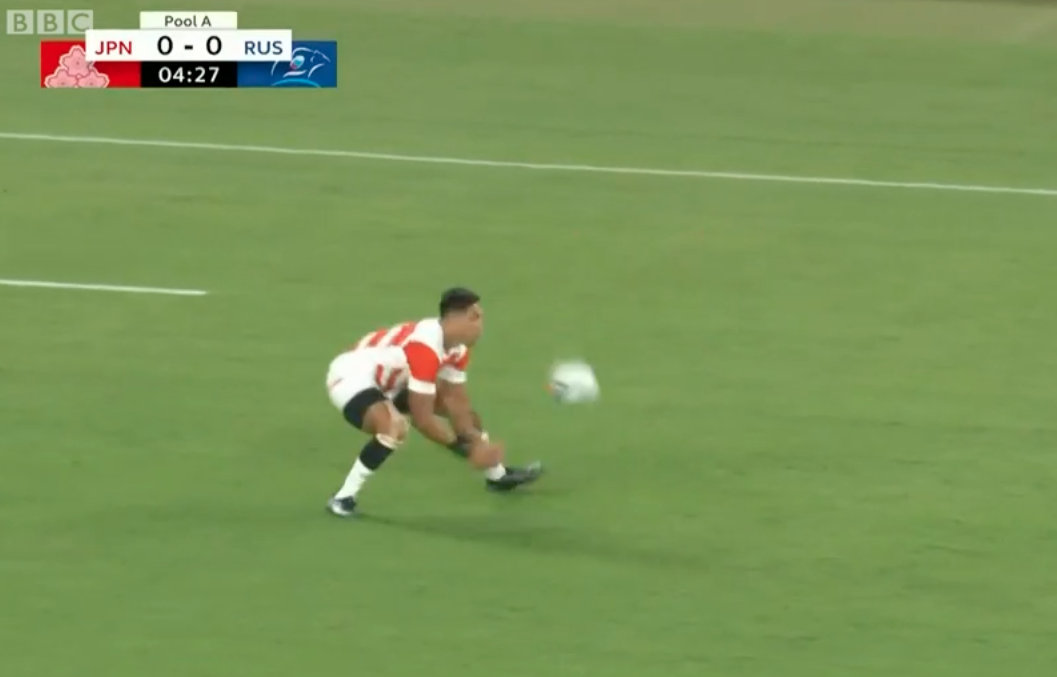
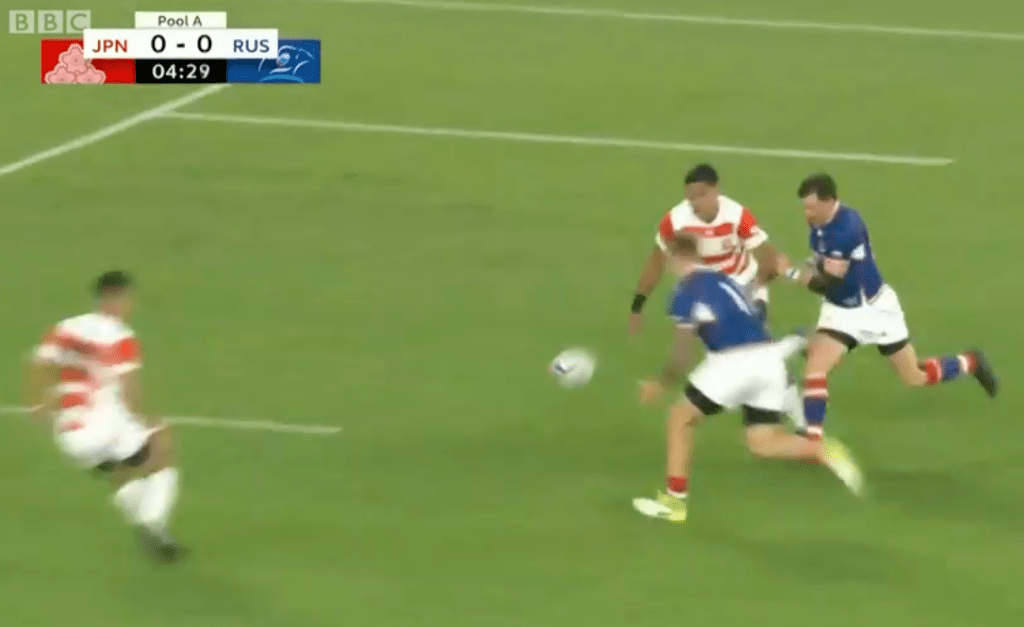
A kick from Russian Winger Golosnitsky, was hammered down to the Japan 22. However, poor positioning meant the ball fell short of the Japanese player, probably focussed on Golosnitsky who was bearing down on him. The kick bounced short and away from Japan, with the Russians momentum pulling him onto the board.

Will Tupou, misses catch leading to Russias first try.
Epitomising a error ridden Japanese performance
Russia latch on Japan mistake to score RWC 2019’s first try.

The overall lack of fluidity and the general clunkiness can also be explained through statistics,with only 0.6 points per attack opportunity. The fear within the team to make a mistake was perhaps best shown when they finally broke the shackles, leading to Matsushima’s first of three tries.

The offload from Timothy Lafaele showed just how dangerous the Japanese will be when they cut loose. The finish as well has really shown the intensity. It will be interesting to see how they adapt in future, and whether they will show more of this flair.

However the general attack from Japan limited this flair, especially in the first half. They surrendered a massive 92.6% of possession from kicks, and overall lost possession 80% of the time with only 20% of their attacks resulting in a follow on. 

So there is a lot to see from Japan and while we saw, some flashes of brilliance, the reliance on kicking and the basic errors restricted Japan from the full throttle dismantling that was expected.

Overall, the Rugbycology rank showed this, with Japan scoring 27. But more importantly it shows the fight that Russia put up with a ranking of only -15.2. A sloppy and clunky Japan put them away but not without a struggle rated in the rankings and most importantly on the scoreboard with only a 20 point win.

Rugbycology Match Rankings
Russia played well, while Japans lack of fluidity effects rankings.

Will Italy be a threat at RWC 2019?


ITALY are often considered out of place at the top table of world rugby. With their inclusion in the six nations inducing a lot of flak and with current struggles increasing calls for relegation. However, not many people have examined why Italy struggle, whether they can become a threat at the World Cup and if there are any rays of sunshine piercing the doom and gloom of the Six Nations table.

Itallian Attack

The best way to understand why Italy struggle is to examine the 2 main facets of a teams performance. Are they scoring and how much are they conceding? In attack Italy can be seen to struggle scoring only 10 tries in the most recent Six Nations an average of 2 per game. This is a standard figure, having watched five additional games we can see the same pattern. Italy scored a maximum of 3 tries, in a game v Japan with an average of just 1.6 across the other 5 games.

Can Italy increase their average tries per game at the rugby world cup?


But why is this so low. Against teams like Wales, Ireland and New Zealand it is understandable, in the Six Nations Wales conceded only 1.5 tries a game. The worrying signs are that Italy only scored slightly above this average v Japan with 2.5 across their games.

One reason for stuttering and struggling attack could be a limited variety. As shown in the chart below, when playing in the five games I analysed, they played in the close channels (Off 9 and Pick N Go) 67% of the time. 

This lack of variety can be expected as not every pass should be going wide, with an increase in ground loss expected. The main worry here is that it differs so much from where Italy should be. As a tier 1.5 team competing in a T1 competition they need to play a wider variety. When examining these games v T1 we see that the Opposition played a total of 57% in Close Quarters. This translates to an increase of 15 phases of wide attack.This dramatic change just emphasizes why Italy struggle, they suffer from the shackles of lower skill unable to break free and play expansively perhaps pointing to a lack of confidence in their wide players.

While I can spout stats at you showing that they struggle to go wide, why do they struggle and are unable to score even when they do attack out wide leading to a low completion of Line Breaks and Red Zone opportunities. 

The main reason for this, in my opinion, is a lack of penetration with a team that lacks a real cutting edge. This is best shown by the 2018 Six Nations Table where Italy scored 2 more tries, than they did in 2019. However while this slight increase is key leading to a general increase of 13 points, what is more interesting is they out scored both France and Scotland, while being within 3 tries of England and Wales. Where as in 2019 they only equalled Wales but scored 35 less points. 

This lack of penetration often manifests itself with a need for the opposition to be put on the back foot and make an error, not something they will find easy against South Africa and New Zealand.

In the image above we can see how Italy have managed to force Japan to over fold leading to a simple walk in. This kind of brain lapse is where Italy tend to score the majority of their tries. For example, when they played Ireland in Chicago they scored a singular try coming from an interception.

This reliance on mistakes will tend to make Italy an easy side to beat. However one of Italy’s strengths is their ability to create an opportunity. As shown in the picture below, after just a couple of phases Italy have created a scoring opportunity, which they convert. 

However, it also points to another problem with the Itallian attack. The majority of the tries come before 10 phases. The reason for this being a tendency to become lateral. In the images below, in a game v Ireland the problem is shown clearly.

In this wide angle shot we can see there are 5 options (there is a runner out the back), however due to the flat nature it means the Fly Half is unable to use any. However this Itallian line creates another problem, when the runner out the back receives the ball his options are cut off as he gets caught in this flat line of half attempted support. 

However, hopefully, this sort of situation can be avoided at the RWC. With increased time together the squad should be able to settle and get used to running these structures rather than having to return to a close quarter game.

Another improvement Italy will certainly have is the introduction of Matteo Minozzi. Minozzi’s electric feet lit up 2018 but his absence in 2019 blunted the Itallian attack. It left Jayden Hayward at Full Back who brought a more astute mind but lacked the flair.

The lack of penetration led to less tries, and less points in general.

Fortunately for Italy and the Rugby World Cup, Minozzi should be at the World Cup having recovered from the injury, offering a sabre to complement the Itallian blunt force attack. 

Itallian Defence

Defence is an area in which improvement is needed for Italy to really succeed and bridge to a Tier 1 team. However it is hard to see any radical improvements happening between the six nations and the world cup. Obviously the longer time spent together will help to prevent simple communication errors but overall, there are some gaping holes which plague the Itallian system.

The main and most problematic weakness for Italy is there defence following set piece. The strange set up they partake in leaves sometimes half a pitch covered by a handful of forwards. 

As shown in the image above Italy have 3 players covering half the pitch. The lack of organisation can lead to holes being left for a quick attack. 

This could well be a problem against South Africa. Look at how South Africa are able to exploit this vs New Zealand. This under resourcing of the blind side could well cause them problems. 

However, to avoid dwelling on the strengths of the opposition there is another chink in the Itallian armour.

In the frame below, you can see an example taken from their game v England, without  the infamous non committal ruck tactics.

In the example, you can see that Italy have been thoroughly stretched off the quick ball. Something that shouldn’t be a problem from an international defence. The lack of cover off Second phase leads to an easy finish for Watson. 

This sort of defensive lapse could well limit the Itallians in Japan. Against the strike power of the Springboks and transition explosiveness of New Zealand it is easy to see Italy being significantly squashed.

Conclusion

Overall, given the defensive problems outlined above alongside a lack of penetration and an easily repelled blunt attack, it is hard to see Italy being a threat to New Zealand or South Africa in this edition. However, Conor O’shea is really beginning to mould a threatening team, with exciting prospects. While they are unlucky with a nigh impossible group, one can assume one thing. 

They will bring an unexpected edge. 

Design a site like this with WordPress.com
Get started