Scotland beat Samoa comfortably but waste chances

After an incredibly disappointing showing against Ireland Scotland were looking and needing to come back. The attack of Scotland had been yet to fire, not scoring a try. This therefore was a major worry. Yet despite this the game against Samoa also required a defensive performance. 

Scotland did really show up against the Samoa in defence, holding them to 0 points whilst the attack did enough despite the amount of handling errors and the inability to convert. This is what really damaged Scotland and showed just how far they still have got to go.They had a forward momentum of 25.7% the mistakes meaning they played the majority of the game in between the 10m and 22. Samoa had a record of  43.8% of moving into the Scotland 22, whilst Scotland languished at 31.6%. This statistic shows an interesting story in the game. Samoa could move and attack but were unable to complete scoring plays.Whilst Scotland got trapped in between the 22m, but able to score when it mattered,

This ability to score when it mattered was still shrouded in a wasteful style of play. Take this Scottish sequence  from a line-out in the 7th minute The ball comes off a lineout with Scotland crashing up the middle

Finn Russel attacks and is able to play to both of his options

The pod is sat slightly backward but Russell has 2 options and finds Bradbury, playing slightly wider and wanting to stretch Samoa. The carry is effective and more importantly the cleanout is quick and the ball is presented well. This means Scotland have fast clean bal for the next phase. From which they use Gray as a carrier and clear this quickly.

A quick ruck clearance enables Laidlaw fast ball to challenge Samoa

However whilst this also allows fast ball Scotland attack back into bodies. This means that they lose all momentum. The pass is a good one but the decision to attack back into bodies makes it easy for Samoa to defend. The decision also has all the hallmarks of being rushed. Russell does carry the ball close to the line but he has runners tracking him, this means that he has to turn, he slips and the ball slows.

Finn Russel attack back into the Samoan defence trying to draw a whole but has little support
Russel throws a pass back and Scotland have to reset

The carry from Bradbury is good and enables Scotland some forward momentum. But the wide angle below shows the damage have done. Having started just beyond the 10m, Scotland have done any real territorial damage. This is symptomatic of the game and Scotland just simply being unable to progress. 

Wide angle shot showing the little amount of progress made by Scotland

Eventually however, Scotland do manage to break the Scottish defence playing off the inside shoulder against an aggressive Samoan blitz defence. This half break enables Scotland to expose Samoa and they can then really begin to attack the holes which are left in their wake. But this break, no doubt frustratingly for Scotland fans  leads to Russel trying to force another chance. The fragmentation of the Samoan line enabling him to play in bhind, but then he forces an offload. Scotland just seeming to lack a temperament of control. This turnover meaning that Scotland lose the new found momentum. 

Yet, this passage of play also shows a dangerous edge to the scottish attack. Shown again in the 27th minute where Sam Johnson and Darcy Graham attack the short side following a scrum. Johnson makes a long run but then throws an offload behind him to the ground, luckily for Scotland it doesn’t quite fall for the Samoan Scrum half. As a result the ball goes out, rather than Samoa being able to play with it. 

Scotland’s first try however came off an incredibly interesting passage of play. In which, following a lineout Scotland kick in behind. Maitland then regathers the ball, but rather than play through the hands, Scotland kick wide yet again having retightened the Samoan defence through a carry by WP Nel. This time, it is luckily regathered by Hogg and won off the ground by Scotland. Scotland then do another carry slightly in field, this is then followed by another cross kick. This time however, with Penalty advantage the kick is perfectly placed and Maitland is able to gather easily and score. 

Scotland manage to stretch Samoa who have shortened and leave space for Russel to kick to.

Just from looking at this wide angle you can see the effect the multiple kicks in the build have had in the build up. The Samoa defence lined up on 1 defender on the inside rather than the winger keeping his width. This means that Russel rather than previously kicking into a crowded area can make a slight misjudgement with the entire 15m area in Scottish hands.

Looking forward, this may well become a tactic for Scotland. The Japanese defence struggled to counter the Irish kicking game. As a result the tactic and set play may be brought again in the crunch game. However most importantly for Scotland if they are going to challenge and manage to avoid an embarrassment they will need to limit the mistakes and play a more limited and controlled style of rugby. Not to the effect that they don’t play with their style of play but merely that they don’t looking in the dark for chances. By trying to force it Scotland lacked a fluidity and as a result it led to an incredibly broken performance.

Scotland show a good rating, however it was against a rather poor Samoa.

Wales provide championship performance in most competitive game of World Cup

Wales and Australia provided a fitting finale to week 2, continuing the momentum of World Cup and providing a brilliant game of rugby to cap off possibly the best week of rugby ever. The game to decide Pool D and avoid a route which could possibly include England and New Zealand was a key game to win and Wales brought a touch of class long forgotten in the first minute of the game.

Aaron Wainwright led Wales’ early charge and preplanned kick off move

The first minute Wales played a strong and aggressive move deliberately targeting a position on the pitch Australia were weak and forcing an error straight away. Aaron Wainwright produces a quick chop tackle lassoing and bringing down Hooper as Wainwright himself gets away from the ruck area.

Wales blitzed an under resourced Australia ruck

lWhilst Australia and Genia look to clear they don’t prepare and secure the ruck well enough, expecting Hooper to have hit the second defender and leaving very little ruck resistance. Instead due to Wainwright making the tackle, Wales have two tight forwards in, Alun Wyn Jones and Ken Owens able to really apply pressure to the ruck.

Wales target Michael Hooper off a carry removing him from the game

The turnover is then secured by Wainwright, giving Wales an immediate possession in the Australian 22 where they could look to attack and really grind for a try. However Wales instead switch immediately to set up the next part of their move. And I use move deliberately, the planning of the first kick off looking incredibly similar to the depth put into a plan versus Ireland in the Grand Slam game earlier this year. On this occasion however rather than kick under the posts, Wales drive a pod in the centre of the field twice. Setting up a field position underneath the posts. Allowing Biggar to set for a drop goal under little pressure as there has been no extensive preparation for the drop goal.

Wales worked the ball immediately to the centre of the field for a drop goal

The specific game management by Wales allows them to immediately return with points showing respect for the Australians while simultaneously laying down an intensity they were unable to match. This first move therefore can be seen as crucial in setting the tone of the game.

However, the main key for the game came in restricting Australian possession when Wales were dominant. This came down to an integral plan for any side. Prevent Hooper and Pocock from attacking your ball. In the play above the first carry is aimed at exactly where hooper is standing again preventing slow ball. Throughout the game, Hooper and Pocock only returned 1 turnover between them. A remarkable feet when you think they combined for 24 with Scot Fardy at the last world cup.

The best way of course to avoid their threat is to make sure the ball stays far away from them. This tactic was no better demonstrated in Wales’ purple patch than off a lineout in the 11th minute. The ball is thrown to Justin Tipuric at the tail. Wales win and Navidi runs round targeting the Australian tail gunner, Micheal Hooper. This pulls him away from the lineout

Navidii runs a looping line off the line out

Hooper shoots to make a tackle on Navidi. However the Welsh Number 8s wider line also brings the interest of Pocock with him. This means that the Aussie 8 is drawn from behind the lineout. From here, George North comes cantering on a hard line. While this may seem counter productive, running at the Australians main threat, North cuts on his inside putting him on his heels.

North carries on a hard line beating Pocock and carrying hard

It also means that North is supported by the heavy pieces. Tipuric is sat advantageously alongside Wainwright able to make a quick clearing pair should Pocock be able to get near the ball. The angle of the carry then brings him also through weak Australians, carrying North from the 22m to the 5m line. Wales have plenty of support nearby and Australia are unable to challenge.

Following a dominant carry Wales target Michael Hooper

Then on the third phase from this move, Wales having cleared pocock out of phase 2, run directly at Hooper yet again clearing the ball free as Hooper gets trapped underneath the welsh support. Including Tipuric who provided a steady supply of ball keeping it away from pilfering hands on most occasions.

Tipuric is close enough to negate Hooper, lining up in a similar channel

In the still above, the 6th phase of this move we Tipuric is yet again working. Him and Wainwright working to hold off Hooper and Pocock from the Welsh ball. The speed off ball also means that hooper is in at 1st defender. This means it is harder for him to easily adjust into a jackaling role as he has to worry about Gareth Davies and can’t immediately focus on stealing welsh ball. Meanwhile Tipuric is close enough to restrict Hooper any access once he can compete.

This incredible work rate summed up wales and in this instance led to the Hadleigh Parkes try. Wales attack may not have been glamourous but the technical work and the hard carrying around the ruck was something of a beauty. I have hardly don’t it any real honour in covering it in such little detail but intended to give a small insight and hope it helps to explain why Welsh dominance was secured for the first quarter.

Australia played incredibly adventurous in attack

But rugby is a game of two teams and it was Australia who exerted the pressure in the second half, bending but not breaking the welsh defence. It was the adventurous attacks in the wide channels that gave Australia a platform. As the graphic above shows, Australia were an attacking force, especially Kerevi who maximised the gains attacking around the edges of the Welsh blitz which allow though at times functioned well, struggled to contain the threat of Australia as at times they were exposed around the back.

While the graphic above does not show the explicit amount of wide plays it does show the Australians adventurous spirit allowed to prosper through Kerevi. It also shows something which maybe a worry for Wales. Who despite their strong overall defence may have given up yards softly, but it could just well be a system weakness. 

I will wrap this post up now, as I no doubt am starting to wear you down and bore you with words. There are many insights I am yet to cover and hope to eventually get round to. 

Overall the game provided a great insight into both teams. Wales yet again shown to be a menace of the first kick when it matters as well as able to defend. The Australian attack has finally turned completely to one of high adventure and looks like a threat which may develop especially if they begin to really exploit the gains they make. Wales however won the battle of white and black styles. Their attack of conservative pressure and sensibilities with 9 kicked exits to Australia’s 0 prevailed at the moment, yet it will be interesting to see if the Wallabies change or stick to this adventurous style of play.

Rugbycology ratings were both positive, the first for Tier One v Tier One game. This made it the most competitive so far.

Uruguay undone by Georgian physicality

Uruguay grabbed the Rugby World Cup by the scruff of the neck against Fiji and with just a 3 day turnaround the feat of reproducing this performance looked herculean. But they gave it all as can always be expected of Los Terros. Georgia on the other hand had a 6 day turnaround following a resilient second half against Wales.

From the first scrum the game looked imbalanced. The Georgian pack pushing Uruguay and being completely dominant. The way Uruguay avoided a yellow card as long as they did in itself was remarkable. However whilst the Uruguayans lacked ballast and technique yet again there can be no fault in terms of effort.

The same defensive system was used as against Fiji from the very first minute. While simplistic in its creation the Uruguayan defence was built on pure work ethic and the forcing of mistakes working to great effect, even when tired.

Uruguay don’t defend from the outside instead applying pressure from the centre

This still from the first 40 seconds shows the Uruguayan defence in its simple nature. Common knowledge is to place a Winger opposite the outside man, try and slow the ball down in the ruck and then once the defence is beaten scramble. Obviously there are subtle difference in various teams but the rush defence in the modern game relies on this. 

Instead Uruguay consistently defend the fringes of the ruck and apply pressure from the very first defender. The example above shows the Uruguayan scrum half having tackled his  Goergian counterpart. The ball therefore is disrupted. However despite the traditional wisdom of drifting immediately and giving up ground in order to push Georgia out of options Uruguay still defend with intent. Rushing forward and forcing the Georgian first receiver to fire a pass across exploiting a ‘ghost’ space.

Georgia are unable to spread it cleanly and Uruguay restrict them

If we play the clip on we see that Georgia where once they had the entire 15 m area practically free they now have only the 5m Channel. This due solely to the aggression of the Uruguayan defence. IF they had drifted immediately Georgia could have attacked with all their players forcing a slower drift and using up the 10m area gradually rather than this immediate transference which puts their handling under pressure. 

By forcing Georgia to reach a bar with handling it changes their psyche. Instead of being relaxed and able to control their own thoughts, they are forced to focus under pressure on their basic skills. As a result of the pure effort from Uruguay they force a mistake preventing true momentum and Georgia exposing a defence which probably could be seen as structurally flawed.

This is not to say it worked completely, and it has one major weakness. Georgia were able to progress 61% of the time by the 28th minute. This just increased pressure on Los Teros as the Lelos were able to pin them back. This coupled with a lack of fluidity from Los Teros, surrendering 66% of possession really didn’t help to ease the pressure.

Statistics from the 30th minute showing Georgian progress in attack

Above shows a graphic from the Rugby United project that I am part and which provides the majority of the stats for these blogs. It points to georgia being able to progress from their 22 100% of the time with both platforms by the 28th minute ending in at least the Uruguayan half. Whilst they lacked progression once in the Uruguayan half, only progressing 3/10 of the times in attacks outside the Uruguayan 22. The 5 platforms in the 22 by themselves tell the story. A continuous pressure which uruguay were unable to really escape.

The ability to control play was coupled with a kicking game which really trapped Uruguay and enabled Georgia to capitalise. The space in behind a rush defence being the easiest to exploit and overall this is where georgia targeted. They often forced Uruguay to turn around on one occasion even forcing a 5m scrum. The overall control due to the kick was something to be admired and applauded and showed flashes of a Tier One nation.

Overall Georgia should be happy with how they played. The overall performance was mature and relied on their strengths. After this game it tees up a game against Fiji. The playoff for third is what will add to the excitement of the group, continuing the flow of great games. Uruguay should not be disheartened a strong attack and practice for their structure is not something that can be overlooked. But the game itself was enticing while Georgia relied on their brawn Uruguay scrambled remarkably well in the first game to require water break. Despite the heat and humidity the game fitted the bill and showed both teams strengths and weaknesses.

South Africa dominant but erroneous against Namibia

The South Africa game against Namibia was became a little lost in the amazing game of Ireland v Japan. Having given a good account of themselves against the Azzurri, Namibia were looking to start strongly and try and learn from the game. A win against the Springboks seemed incredibly unlikely and so it prevailed. 

Right from the start of the game, Namibia started poorly. A failure to exit their lines showed just how much of a struggle the game would be. Form a South African perspective it was a solid start and they set about asserting a physical dominance immediately. The scrum was where this started with Namibia being completely dominated.

However, Namibia were at points able to frustrate SA and prevent them from playing right through. Their scramble defence allowing Namibia to really fight on strongly stopping SA from scoring within the first 10 minutes.

SA resorted to their maul to finally break the Namibian defences exposing a key weakness that would garner a lot of points and momentum for the South Africans whose forwards set the tone for a dominant performance. Francois Louw scoring only 5 minutes after the first try. However at times, the SA backs also caused problems making breaks and keeping Namibia pinned back leading to a yellow card following a slap down deemed cynical by the ref.

For South Africa however there had been 6 errors against incredibly weak opposition. This therefore should be red flagged, with Rassie Erasmus having plenty of time before the ‘serious’ stuff begins. The handling errors led to an uncharacteristically low opportunities to points rating given the opposition. The rating of 19.1% sat them only 4% clear of Australia’s game against Fiji and perhaps crucially only 7% clear from the French in their game against Argentina. The low opportunities taken should definitely be a worry for Rassie Erasmus’ men. 

South Africa did score with their backs and it is this I will attempt to examine below. The first try that came through the backs starts with a line out just in the Namibian half and started  with a quick throw to Francois Louw who was not thrown in the air but instead merely received the pass expertly exposing Namibia switching off. This allowed fast ball for the South African’s who crashed the ball in with the first pod. This created a tight group of forwards close to the break down.

Off a trick play lineout SA crash it up the middle thing in defenders.

By isolating a winger and then targeting the edge of Namibia’s split defence South Africa are able to trap the Namibian forwards folding round. This coupled with a dominant carry from Frans Steyn sets South Africa perfectly central and enables them to attack from a solid base of possession.

Schalk Brits is the lead man as SA crash again able to put Koch through a gap.

Following this quick ruck, South Africa loop around the ruck. Another pod of 3 led by Number 8 Schalk Britz targets the same area again, with the third defender in from the touchline trying to make up for previous ‘weak’ defending and put in a big shot and slow down the South African attack. However. Brits is able to pop it off to Koch. 

Brits and the Beast work hard from the pod to support Koch and create quickball

Koch’s angle means that the Namibians bunch together with no other defenders wider than those in frame. This means that when Jantijes gets the ball he can expose space on the outside of the Namibian defence. The Pod system also works to free the ball quickly from the ruck. Schalk Brits able to support his teammate and prevent any untoward pressure. Whilst the beast is also there to either offer an option or finish up and protect the ruck. From the ruck Jantjes fires it across the face of the Namibian defence allowing the Warwick Gelant to quickly accelerate onto the ball and beat the outside edge, a characteristic which has become key at RWC 2019. The skipping of South African hands also means that RG Snyman can run an inside supporting line preventing the Full Back from drifting even slightly onto the outside man.

Grant receives the ball and fixes the Full back. Trapping the Namibia 9.

This also has the added benefit of trapping the Namibian Jantjes and allowing SA easier play. This gives Mapoe an easy finish with no Namibian able to cover the back field and the first line of defence unable to realign fast enough with SA managing to break through the centre 2 times and cause them to be retreating rather than defending positively.

This perfect example of using pods shows just how clinical the Springboks can be. However we must still bear in mind the underwhelming nature of their attack. With 6 errors by the 32nd minute this was hardly an amazing performance. Given the nature of the loss to the All Blacks previously, which using adjustments to the rating system left them languishing as the second worst Tier One side above Scotland shows that the Springboks have got a lot to work on if they are wanting to be in the equation come the 2nd of November.

Rugbycology ratings show that SA were dominant but it’s not hard to see the ease they found attacking and defending against Namibia.

Argentina stagger after strong first half to beat to Tonga. 

Argentina appeared to start strongly against a susceptible Tonga before taking their foot off the gas. However while they appeared comfortable the Argentinans may feel lucky. Tonga began to really exert pressure again the Pumas in the last minutes of the half before creating a real contest in the second half.

The Tongans however as you can probably tell from the title, were beaten by the first half. Argentina starting with true dominance in the forwards. The first try exploiting the dominance and Tongan fear of the Argentinian team.

Using a fake maul, Argentina were able to attack round the front exploiting the space in the 5m channel. Simple hands in this channel allows the Argentinans to attack and score. The fear in the Tonga’s defence leaves their hooker exposed. 

Argentina used a decoy maul to great effect

By setting up with a maul the ball is obscured. The crucial movement does not come from the forwards, instead triggered by the Scrum Half. As he loops to the openside, it drags Takula from behind the maul. This coupled with the movement of Argentinas forward close to the maul really screens the Tongans, preventing them from challenging. 

The crisp movements allow Argentina to expose the short side. But the ability to exploit at the beginning of the game and create a trepidation in the Tongan forwards about commiting to mauls lest they be exposed at the front again is crucial, and allows Montaya to score his of three.

But it was a poor decision making in open play that put Argentina in control. The first 2 tries coming from forward dominance and close pick and gos but it was Tonga’s game sense or lack of that really damaged their chances. 

The third try comes off a lineout move which goes to the ground twice before the Argentina are able to pilfer it and run the 50 metres to the try line. 

Tonga were chasing and began to throw stupid balls allowing Argentina to extend their lead through simple finishes

By Takula throwing it off the ground it shows the pure desperateness of Tonga. They want to try and emulate Fiji against Australia instead this sort of play makes them seem like their pacific brethren against Uruguay. While this result was never likely to be upset, you would expect more from Takula. The continuous chucking of the ball damaged their chances and instead prevented them getting real momentum.

They surrendered possession 57% of the time keeping them behind the game and preventing any real exploitation of chances. However the Pumas had 53.6%. While not a big difference it was the key difference. Tonga had a better chance of scoring in Argentinas half than vice versa but were unable to make it pay.

This statistic also looks better after the better second half. Following the first half Tonga had given up 83% of their possession. As a result they just Argentina the ball as described above meaning that while Argentina didn’t really need to create much they were able to pull away not relying on superior skill but the inferior decision making of Tonga.

Overall the Second half saved Tonga blushes, having become the fastest team to concede  4 tries this tournament they fought back admirably restricting Argentina whilst creating using flair and skills that they failed to show in the first half. However don’t write Tonga off, given this Second Half performance they could well become a threat to the French side and pull off a 2011 style upset. Argentina however should be happy but not joyous. The taking of foot off the gas while not damaging was something which should be avoided in future. However overall Los Pumas avoided a potential banana skin and must now begin to prepare for the England game.

Toga despite a fight back in the Second Half were never able to challenge Argentina as shown in the ratings.

Japan pull of upset against Irish in Miracle 2

The rugby world cup needs a story and we have been spoilt for choice. The conditions have created wins that we don’t deserve leaving many prediction models in tatters. But this weekend the most important line of the story has been written. After the introductory game against Russia in which they were sluggish the Japanese created history against the Irish.

Ireland started well, completely in control at the beginning of the first half looking comfortable. The kicking game of Carty showed his confidence as he bedded into the game almost immediately. By the 11th minute Japan had kicked clear from their own 22 on 5 occasions from the 6 attacks beginning in their 22. However Japan did exert their own pressure with solid progressions attacking down the centre of the field.

They did show some weakness under the high ball and dealing with the Ireland kicking game. This is why it was so shocking to see the Irish fail to exploit this especially given their early success.

Ireland started strongly with control and a clear structure.

The build up to Gary Ringrose’s try really showed the irish attacks intentions. Starting as shown above in the 15m channel they hit pods in the centre of the field 3 times in a row. This drags Japan around until they reach the 15m on the right and then appear to want to shift in field.

Ireland attack behind a screen and target the blindside
Ringrose is able to find a weak shoulder and help Ireland really gain momentum

With Ringrose hidden behind the pod Japan realign to defend a switch in the attack direction. This hiding of ringrose enable him to add real momentum to the irish attack. He attacks at the shoulder of the loose head prop and is as a result able to exploit a small gap with his stellar pace.

Ireland return to pick and go’s once in the Japan 22 to tighten the defence again

The break is then followed up with with close play. Ireland make it up to just short of the Japanese 5 metre line. They then continue the same pattern with close carries working their way from the 15m channel to underneath the posts with even the backs beginning to carry in the typical pod formation.

The close work from Ireland really drives them forward. It also brings the Japanese defence over to the openside having to readjust. This overall structure opens up space on the blindside, as the Japanese defence sits back Ireland really increase the width of the carries. This forces even more work from the Japanese. Yet while one pod of backs is used, Gary Ringrose is not used. He instead stays on the far wing. Sitting outside the final Japanese defender who leave the majority of the 15m channel free. 

Ireland switch back again and are able to expose poor positioning from Japan

As a result Ringros is able to attack him from behind and jump over him. This therefore leads to an easy chance. Carty’s kick is also incredibly good, the confidence carrying over from his performance and the current control he is exerting.

Interestingly while Ireland scored from this, and set up other chances, namely Earls managing to go free from his own half. Yet the confident kicking really died off in the second half. A team of Ireland’s quality should have continued to use this tactic but they lack a significant game sense for some reason. Scoring two tries from kicks it is a wonder Ireland stopped using the kick to try an upset Japan.

However, Japan also dealt well with kicks that allowed them to attack. By the 39th minute Japan were yet to start an attack in the Irish 22, instead progress was the name of the game. They averaged 78.6% exit from 22, third overall against Tier One nations, with only Italy and Ireland against them. (The Irish average taken before the game, in the game sitting at 60%)

This turning of the screw, with phases from Japan right at the end of the game was a turning point. At minute 39, Yu Tamura kicks a penalty a just reward for their efforts, but it was what happened in the next phase that is interesting. Ireland kick to long from the kick off Allowing Japan to start at the half way line instead of in their own half. Then with the clock in the red Japan, rather than putting the ball immediately out instead attack. From the scrum they attack Earls wing, reaching the 15m line and making it to the 10m. From here Japan use pods to attack down the centre and bring in Irish defenders. Then on the third phase they spin it wide reaching the opposite 15m line. Then following two switch back pod drives they spin it wide again. Finally gaining true forward momentum.

Japan show real intent attempting to reach the wide channels and bring Keith Earls into the attacking line

Exposing the space outside the Irish defence, Japan are finally dominant relying on guile not strength to break the green wall. The use of Japanese hooker, Horie allows them to play more expansive. Compared to many of his positional colleagues, Horie is a more mobile hooker, one reliant on handling rather than a tight carrying game. As a result he stands often at the front of pods able to pass balls off and make the decision as a first play maker. This added dimension enables Japan to be play with more fluidity.

A carry, from Matushima, following some more toing and froing brings Japan up to the 22. Then following another carry Japan carry again. Horie having held his position from his carry against Henderson now is sat in the wide channels. And against, mainly ridiculous, conventional wisdom kicks in behind.

Japan attack out wide with Horie taking the ball yet again at first receiver

Noticing Earls is flat and that Japan has a numerical advantage Horie’s kick rolls in behind and the Japanese winger is inches away from gathering the kick only for it to evade his clutches and roll into touch. But the added 3 minutes of play showed not only the technical and tactical skill but may possibly have had the added effect of wearing out the Irish side in conditions incredibly different from weight nights in Dublin.

In the second half, Japan really began to turn the screw. By the 48th minute reaching 6 max progressions, despite only 50% progression overall. This general trend of knowing when to attack and when to control the game from deep really turned Japan into a threat.

By the 57th Minute Japan recorded their 1st attack starting in the Irish 22, after an accidental offside from ireland. As a result Japan start with a scrum and are able to bring out a move specifically designed for this situation. They start with a pod crashing straight in, down the 10/12 channel. This forces the Irish to split their defensive line with mainly forwards remaining on the large blinside. Tanaka runs to the blind. The nuance to this play comes Lemeki, who has sat behind the play ready expose an overaggressive guard defence.

Japan are able to run a set piece move off the scum and hide Lemeki well

He floats behind the line and then comes on an incredibly hard line and brings japan to within 5m of the Ireland line. The beauty being that while most moves would have moved most backs into specific positions to take advantage and exploit this, Japan are able to realign and attack with an almost 100% complete back line. 

Following Lemiki’s carry Japan are anchored to the Irish 5m line

After a few carries to pin the forwards close to the ruck and prevent support filtering it’s way out Japan strike wide again in a deadly 1-2 to take the lead. The ball staying within the 5m to allow Fukuoka an easy chance to score.  This single move emphasised the difference in the two teams. Ireland struggled to adapt to conditions, as mentioned in commentary looking out on their feet and untypically sluggish. Japan however struck with quick plays making the most of their limited chances, resulting statistically in a 27% chance of scoring when in the Irish half.

Ireland should be worried the general feeling around the side needs to change. The sluggish nature is probably a mental one as despite ample time to adjust they looked off colour. However, most importantly they needed to stick to their strengths. They kicked 42.9% of their possession, 2 kicks ended with an irish score.So their movement away from this in the second half is completely bemusing. The general drop from 61% against Scotland is shocking and just shows the effect that Japan had on them almost entirely dictating the game, controlling the second half. Japan however decided the game through their ability to take points. Their scoring proficienncy putting them above New Zealand and England in terms of platforms to points. This game may not have decided the pool but it has well and truly blown it open and given Japan every chance of a progression.

Rugbycology ratings show just how off the pace Ireland were.

England comfortably see of Eagles. 

Much has been made of the Eagles rise, the victory against Scotland last year helped to announce the USA’s arrival on the International stage. This victory v Scotland was a strong performance but the game against England saw their threats nullified. The USA struggled to get any real possession having to play out their own half frequently.

This kick game however needed it was played right into England’s hands. Starting right at the beginning of the game. The USA kicked from their own 22, the ball travelling just to the touchline in their own 50. However they struggled to find grass, with Ford catching it on the full.

Billy Vunipola sat deep waiting for USA returning barrage

Obviously England were prepared, almost treating the kick return as a set piece. This meant that Billy Vunipola was sat right back. Able to see the US defence coming up Vunipola was able to isolate the USA openside, His slight change of direction enabled him to break a loose tackle and really make ground. It also meant that he split the line and was running at Macginty. The low tackle from Macginty struggled to bring him to the floor. Then following this England were able to spread the ball. This was a theme of the attack. England attacking from wing to wing spreading the ball following each break.

Billy Vunipola carries hard in outside channels

The carry in the outside channel attracted in US defenders. As a result of this momentum England were able to attack positively. George Ford bossing a traditional shape. Kruis on his inside, with a pod of 3 on his outside. However with adherence to a pre planned move he shifts the ball out the back, Elliot Daly fulfilling his role as a secondary distributor.  The ball moves across and Cokasinga carries. Interestingly Cokasinga stays inside of Piers Francis using his carrying threat to prevent the over drift of inside defenders shutting down Francis. 

Joe Cokasinga was deployed in wide channels however sat inside Piers Francis

By the time Francis receives the ball he is in the US 22m, a real show of superiority by England, their ability to progress was a key theme of their dominance. They recorded a progression of 61% from US 50 to the US 22. This general pressure would keep telling on the US themselves only escaping the English 50 to 22, 8% of the time. However while it seems great in this context, England may have a little problem with their general progression from Opposition 50 to Opposition 22 sitting at 21% of the time the joint lowest of Tier 1 sides. Especially having played Tier 2 teams you would have expected this to be higher.

However the clinical nature of England when in the opposition 22 was great to see.  They converted at the same rate as New Zealand, at 11.1% of opportunities. This stat after especially after significant rotation showed just how well England were playing. 

The passage described above, resulted in George Ford’s try, yet England didn’t score again for the next 20 minutes. The USA perhaps beginning to cope with the English team’s kicking game.

However, the game also saw England ruin the US mauling game. This was good to see, whilst not like the backs where a team may want to conceal a tactic or move, in defensive mauls it is just a time to see the team’s preparation, and for English fans at least this was a positive. 

George Kruis started directly in the centre, but moved forward
Kruis wrapped up the ball winning a turnover

George Kruis was a menace, completely breaching the US defences at the maul to lock onto the ball and win a turnover in the 15th minute. This is incredibly interesting, especially due to the apparent lack of specialist maul defenders at the World Cup this time round. This means it could be a really valuable asset especially against Argentina when looking ahead. 

However England didn’t have it all their own way, a fiery performance from Brad Davies meant that Willie Heinz was kept under pressure at times. The prevention of England’s clean service definitely helped the US keep a respectability upon the scoreboard even if they struggled to actually escape their half. 

Overall, England came out with an assured performance. While nothing to write home about the performance did show some interesting advances on their game plan. Most importantly they began to really execute a kicking game. They kicked 46% of their possession really tightening the screw. USA had some bright lights yet some simple errors at a time restricted them but they were not able to create due to the suffocating nature of the English defence, another positive for Eddie Jones’ men.

Rugbycology ratings show that England were dominant against USA who struggled to escape their own half

Itallian back row shine as Canada squander chances

Itallian back row shine as Canada squander chances

Italy and Canada had the misfortune of following the greatest game of the tournament so far. However, they didn’t struggle or languish instead serving up a great game in which the very cliche of the score not representing the balance of play summed up the occasion. Canada created opportunity however the ball often went to ground. 

However it was the hard carrying of Polledri, Steyn and Negri that opened the game and allowed Italy to prosper. Throughout the game they dominated. Polledri alone racking up14 defenders beaten. This wondrous performance from Polledri was matched by Steyn who notched a try and 5 defenders a beaten, a tally matched by Negri.

However, while it is important to show their gravity and prowess using statistics, their involvements also garnered momentum and were more integral than simple numbers. The  Bellini try cam from 3 specific interactions from Negri and Polledri. Polledri took the ball, from Negri, off phase 1 following a kick from Canada. Able to run a slight arc he targeted the space. Then he accelerates with Negri realigning as Polledri plays to Allan. This means that Negri becomes the first receiver. From this Negri is able to pick a perfect pass and split canada and one which allows Bellini to accelerate and score. 

Negri positioned himself at First receiver able to free Polledri

But let us examine Negri and Polledris direct involvements in the play. By receiving a second receiver, it gives Polledri an open the shoulder and allows him to exploit the space. If he stands at first he can be cut down as the Canadian defence is tight, following a kick chase at the end game.

Je akpolleedri leaves Canadians in his wakes as he rampages up field

The movement also showed Negri’s integral role to Italy’s attack. It shows a real development no being able to play with a forward at first receiver. The high quality rugby and the decision making of Negri plays a key role in the Itallian attack. IN this passage he plays First receiver twice. His first decision to free Polledri and then keep working to get on his outside to Allan can fill in on the inside is integral to the flow of Italy.

Ciarn Hearn has created a dog leg in the centre of the field

From the calmness of Negri, Polledri is able to rampage up the field leaving a few Canadians in his wake. As he approached Ciarn Hearn he has a decision, either to pass or hold the ball. Polledri backs himself, rounds and accelerates from Ciarn Hearn who had created a dog leg in the Canadian defence. This confidence allows Polledri to begin to pull away from hearn. IT also gives forward momentum to Allan. His next decision to cut towards Allan keeps the move alive. While it might seem counter productive to run away from the space and towards the defender it  forces the full back to turn in. Following this he then gives a pass to Allan. While this causes the attack to slow slightly it means Polledri can clear the ruck, allowing fast ball for back row partner Negri.

Again Negri positions himself at receiver, enabling Italy to play fast with 3 options of Negri.

Negri’s work rate has enabled him to set up as the lead man and he begins to take control. He communicates directly with the scrum half. And his pure physical size keeps Canada honest especially after Polledri’s physical carry. This means that Negri can run forward and take advantage of space, drawing out the canadian defence.

A wonderful pass frees Belinni on the outside

The decision of the Canadian winger to rush and shut down the option is down to a lack of communication and leaves Canada exposed an opportunity Negri is more than happy to take. The calmness and control from Negri could not be in more of a contrast than that of Canada. Canada created opportunities from which it was possible to possibly create 3 or four tries. None more clear than Ardon’s break with the final pass going to ground early in the first half.

Tyler Ardon manages to break Italy’s defence with an option out the back acting as a decoy.

As Ardon, the Canadian captain, break the line following a disjointed defence due to the presence of multiple poptions. He makes the break and begins to accelerate towards the full back. He even opens up more space, like Polledri running at a specific shoulder of the Full Back.

Ardon caries instead of giving an early pass causing Heaton to truncate his run.

Ardon however decides to seek contact before passing. He goes to offload killing Heaton’s momentum in the middle. This is inexcusable with a 3 on 1 being wasted due to Ardons carry with his offload going to ground. Even had there been another defender covering, by passing early to heaton it would have created a more fluid movement and allowed Canada to score but his carry instead of making the chance early by preventing the Full Back repositioning kills the Canadian attack and creates added difficulty.

The amount of chances wasted by anda including the one above was the tone of the game. It meant that the score looked like a walk over but Canada could have been a lot closer had it not been for the errors. But it was the Italians backrow which allowed them to prosper. Creating and supporting opportunities and giving Italy opportunities for progression leaving their 22m 47% of the time. Interestingly Canada progressed from their defensive half a a rate of 92.1% showing just how much the errors damaged their chances in a game, they were targeting.

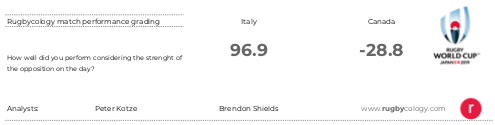
Rugbycology ratings show that Italy were supreme while Canada struggled to finish opportunities.

Uruguay defeat lacklustre Fiji

The game between Fiji and Uruguay took place on historical ground. Not for the best tries, not for a nail biting World Cup decider. But in the smallest stadium of the World Cup, one packed with passion and emotion. The history of Kamiashi should not be lost amidst the celebration, an area devastated in 2011, only to rise to the challenge of the World Cup (much like Uruguay) and host the game of the tournament so far.

It was a game started well by both teams, but looked like Fiji would waltz away with the game scoring first with a tight carry to the maul, and one could easily have given up hope and lost interest. But something was moving, the Fijians lacked a clinical edge while Uruguay defended ferociously.

Uruguay’s aggressiveness in defence can from the outset.

The intent was set out by Uruguay off the second phase. A Huge double tackle in the centre of the field showing a fight not expected and a physicality not reacted to by Fiji. And while the tackle ended with a Uruguayan knock on, it showed a clear intent. After all whilst it was poor kicking from Fiji that lost them the game it was the aggression and strong defence of Uruguay which gave Los Teros a sniff.

Fiji were able to make gains close to the maul.
Uruguay’s lone was broken but manage to swarm Fiji

The defence system, both it’s positive and flaws were shown perfectly in the 17th minute. It starts off a lineout with the two Uruguayan fringe defenders focussing on the scrum half. Almost enabling Fiji to break free. However, Uruguay recover with an ability to keep working.

The Uruguayan defence backtracking and shaping the Fijian support well despite contesting with two pods. This work was to sum up Uruguay throughout the game and the rest of the move. 

After a while Fiji, have shifted it from side playing laterally with a few one up runners making it easy for Uruguay and Nakwara unable free his hands. Following a series of phases, though they have opened an opportunity with one of Uruguay’s defence blitzing, up with the Fijians able to free the ball. This leaves Uruguay in scramble mode. Fiji should really score the first time around, with 2 defenders trapped in the 10m channel and a free Fiian in the outside 5 metre channel, but they don’t pass.This strong work enables Uruguay to shut down the attack.

Fiji managed to find the outside edge a lot v Uruguay
They failed to convert opportunities. Uruguay just about holding firm.

However the aggressiveness with which they played had been exposed. Fiji able to find the edge and with so many competent handlers and attack minded players you immediately wondered if Uruguay were going to start defending ‘’properly’’’ and preventing Fiji free space.

But for some reason Fiji had forgotten who they were. They played fast and loose, incredibly loose. This led to 10 handling errors in the first half. More worrying it was the effect of these errors. Often without much pressure, but then Fiji begin to feel the heat.

One clear example of this handling going wrong was Arrata’s first try. However, whilst the handling is poor, John Mckee should have been more worried about the work rate following this. Fiji just stand back allowing an offload off the floor to Arrata straight through a a central channel. This work rate whether affected by the Australia game or not is really poor. Especially given the opportunity, if the ball is passed wide Uruguay may get caught short but the Fijians stand still, allowing Los Teros to pounce.

Uruguay were the first to react to the dropped ball. Fiji seemed off the pace.
Fiji don’t realign to cover the gaps sound the ruck.

Fiji kept trying to play, attempting to pick of Uruguay. But the overall attack was lacking, even from kick return. Veikotani, of London Irish, had started brightly but when he returned the kick was stipped, and with little support around him Uruguay made easy meters. The style Fiji play relies on support, and from Aratas try to the lack of it on Fijian kick return, Fiji seemed off the pace.

Fiji give up a turnover and don’t react allowing Uruguay easy gains.

There were opportunities aplenty in throughout the game. But Fiji seemed unable to really control. They had a clear advantage in the forwards but seemed to lack any real leadership that focused on this strength.  The general attack could have prospered with less errors, especially given how aggressive Uruguay were. 

The general lack of finishing ability was exposed by Uruguay’s passion. Freitas working back to shut down an immediate try at the beginning of the second hal really showed this. Fiji have a 3 on 1 manage somehow to bungle it completely not only not scoring with the try line in sight but surrender possession with the Freitas intercepting and clearing for Uruguay.

Fiji worked a 3 on 1 in the outside channels. They had plenty of space and time
Freitas was however willing to keep working back and try and stop a score.
Fiji became frustrated and stopped playing after multiple mistakes.

And while Uruguay were not clinically it was their kicking and the game management of Man of the match Berchesi which won the game. Take an instance in the 34th minute. Uruguay are camped in the Fijian 22 for 13 phases and where most sides would go for the jugular Uruguay act calmly and take the points. Not relying on their attack which prospered off broken play Uruguay kept their heads in front, able to just stay clear from Fiji. Fiji kicked at 16.6% of their kicks. Meanwhile Berchesi calmly did enough at 85.7%. The pressure of the tee was where Uruguay won and Fiji lost. This pressure meant Uruguay converted 13% of opportunities to points bettering Fiji by 2% and in a game decided by close margins, this was the closest of all.

 You want to say it was small margins but this was just careless from Fiji. Perhaps people shouldn’t be surprised. They struggle v Japan, maybe the hype around them beating the Maori All Blacks and being close against Australia has put this out of context. But overall they were away from the Fiji they wanted to be, we wanted to see. This all down, not to genius defence or pure skill and talent. But grit determination passion history and heart. Uruguay took the game to Fiji and completely shut them down not through a Brendan Venter system of defence but through hard work. 

The Rugbycology rating shows how well Uruguay played dispatching Fiji.

Poor Samoa win game against Russia

Samoa and Russia served up a less than remarkable game, in which Samoa Struggled to really assert control. The game will be marked by controversy, not covered here, for hits from Ray Lee-lo. But this background sets the stage for an at times dull game of rugby.

The game was filled with errors, with both teams unable to really assert any real pressure. It started well enough for Samoa, with a charge down immediately of a kickoff, a hope that it’d have interesting moments fueled by brilliance was kindled. But then Vui gave away a basic penalty at the lineout, spreading the smoke of disappoint.

It waited until the second half for things to get really interesting. This started with a try for Samoa scored by Fido bat attacking the space next to the maul. Thi was all catalysed by TJ ioane and a lovely set up off the back off the maul.

Samoan set piece, allows TJ inane to free his hands

Ioane’s pop off is triggered by the scrum half breaking to the blindside, this drags the russian defenders for a split second leaving just one defender to deal with the actual russian ball carrier. This means that when Fido comes on the inside, with the russian flanker going for a big hit, he is able to get through without being touched.

Fido attacks gap left by overly aggressive Russian defence

This small move exposed russian reactions perhaps wearied as the 23 played their second game in 4 days. This also can probably be used to explain why Samoa struggled to assert true dominance over the Russians, until the 50th minute when the floodgates opened. Russia Falling away rapidly coupled with Samoa being able to play with significantly more freedom.

This freedom was then also given time to breathe. Russia’s aimless kicks allowed Samoa to really attack. This was also caused by Russia leaving a gap between the winger and the last main defender. This meant that a massive dog leg was formed in the russian defence. 

Alpati Leuiua breaks the line following a kick return

When this happened the samoans were perfectly positioned to expse this. The speed at which they hit the ball gave them a significant advantadge. However the Russian scrum immediately transitioned into a sweeping role. This meant Leiua was unable to find support instead running into a diamond of Russian defenders.

Positive kick return however without support

However, while Leiua fractured the defence they managed to reform, his meant that hile Samoa had momentum it was partially stalled. There were still some bright sparks but after the original breaks they immediately reverted to hard carries in the middle channels.

However Samoa were stil able to break tackles of the Russian defence, alowing Tim Nanai Wlliams to make a break down the field,this finally breaking the Russian defence and giving Samoa an oppurtunity.

Samoa pick and go close to the ruck open a gap and creates a second Linebreak opportunity
Russian defence broken with very little cohesion

This series of plays led to Ed Fidos second score. The ability to free hands in the final phase was something possibly missed during the game. The continuation however was a clear positive from the move with the ability to finally press home an attack something previously missed leading to 13 scrums.

Russia however offered little threat in the contest. The best example being when in 67th minute they became camped upon the Samoan line. They seemed merely happy to sit upon the Samoan line and try and drive. However samao were able to fortify their line and a couple of spills (backward) took the ferocity of the attack. The period of 4 minutes ended with Russia coming away with no points telling a resounding story in which silence upon the scoreboard told the story of the game. 

Rugbycoloy ratings shows the poor performance from Samoa, only scoring 15 points when Italy had recorded 100+ against a Namibia team the same standard of Russia

Design a site like this with WordPress.com
Get started