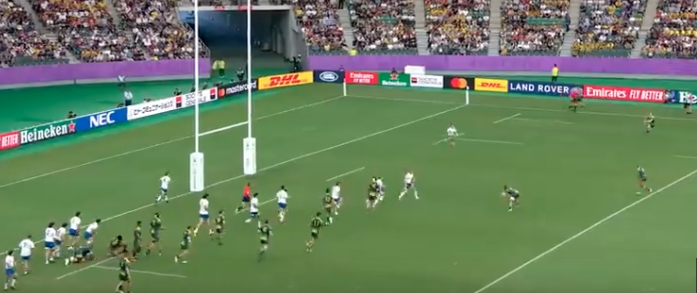
Periodical French Flair puts away Tonga

In a close game in Pool C before talks of Typhoons and cancellations, France ground out a win against a strong Tongan team. The overall performance was characteristically french. The flair came through till the 45th minute. However after that Tonga wrested back control forcing increasing mentions of the game in 2011, where Tonga beat France.

It will be the French flair that I will aim to focus on. The simple strategies and techniques that France used are demonstrably difficult to detail and may well derail Wales in the Quarter Finals. The exploitation of space, against a suffocating defence will be an interesting battle,but back to Sea Eagles instead of Dragons.

If we look at France’s first try, scored through the combination of Raka and Vakatawa we see the ability to exploit space clearly. The conditions that enable France to prosper are created by a Tongan mistake but it is their natural rugby style that enables the exploitation of the mistakes.

Chats hard carry at the Tongan 10 gives France a good basis to attack from as he stays on his feet.

Chat, wins the overthrow and partially bounces off the Tongan 10. Being unable to complete the job however he stays on his feet. As siale Piatau is shooting up it leaves a dog leg which is exposed.

France maintain depth and speed to expose slightly disjointed Tonga

This gives Raka freedom to attack directly in the wide channels, and unfortunately for any defender the ability to gain speed. The carry is devastating, really working to go through the contact.  This draws in the inside defenders to him, and gives France the perfect attacking set up. 

Raka Is dominant in his carry but French support on both sides makes the try happen.

The support has carried on both sides of the ball. This means that despite the tackle, France are able to attack space quickly through the offload. The skill delivers the ball, and enable Vakatawa an unopposed finish.

However this all stems from the calmness of Chat when he wins the ball. His dominant carry could have led to a ruck instead he uses his ballast to offload, enabling Ntamack to free the French backline.

While the above score shows France’s ability to expose wide channel space it was their work in the tight channels that catches the eyes. To some degree all international teams should be able to expose the outside channels, but the heads up notice of the space in 5m channel was incredibly pleasing to see.

Serin lines up at the Front of the lineout in an ever more common set up

As you can see in the still France have Serin at the front of the lineout, this means they have him able to loop around for the ball once the jumper has secured it. It’s a common tactic and hence the Tongan front lifter is facing in. It is this space Serin exposes with a simple 2 on 1 being created.

France keep the ball in the tight channels. Whilst support is arranged behind.

France are then also able to react with speed, their openside tearing through the Tongan lineout in support for Chat. This keeps the play alive and stretches Tonga even more. By keeping the ball alive it also means more French support can support the carrier. WIth a pod of 3 in support it gives France another chance to play off the deck.

France stay on their feet and keep the ball flowing

By staying on his feet, the openside can offload and play the ball to a hard runner (currently being tackled), who then offloads to Vahaamahina. The work by the openside then to keep the blindside open, allows the try to be scored. Except of course it is disallowed. 

The pass goes forward, in a microcosm for the match. The French do something incredible and then almost pull off a contender for try of the tournament. The completely unplayable attack is then let down by some overzealous attacking.

Tonga also played well however, and it would be unfair to dismiss the sea eagles. The fight and control they brought in the second half was outstanding. Throughout the game they had patches of brilliance and putting down chances which meant it became a what might have been sort of game.
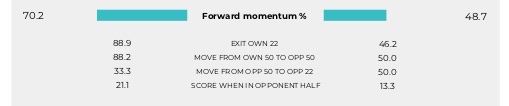
Stats from Rugbycology study show that whilst Tonga were good in attack they failed to clear their lines.

Throughout the game they invited pressure onto themselves as a result of simply not being able to escape their own 22. The inability to move from it, even with kicking included shows the general problem with the Tongan attack. The handling also led to them surrendering 80% of the ball. A genuine problem restricting a possibly historic win.

Frances ability to cut a team open in many ways will be a worry for Wales and any other opponents should they progress further. Over 10% of their platforms they converted to points, with a massive 20% chance of scoring in Tonga’s half. The variation shown in attack coupled with the ability to really control the flair will be key if France are to fulfil the promise of the halves of rugby they have produced. Tonga gave a good account of themselves but key chances went to ground and the fact they converted at a rate of 0.4 points per platform compared to 0.5 of France was really the difference. As Frances ability to exploit key moments shone through.

Tonga score a great rating, whilst France sir below where they’d want to be, a good indication of the game for both teams.

Brutally efficient NZ put away spirited Namibia

New Zealand continued their march for the Quarter Finals with a comfortable win against Namibia even if they were kept under pressure by a good first half showing by Namibia. The taking of opportunities and the general efficiency of the All Blacks was key to success and bodes well for their future. 

By half time they had left with points on 18% of their attacks. Yet, Namibia had kept them under pressure. Taking pints on 13% of their 22 opportunities. Whilst all these points came from 50m area, for a team of Namibia’s quality this is a high return. Meanwhile, they will hope to improve their progression to the NZ 22m area.

New Zealand set a maul with Namibia committing to stop the danger

NZ’s efficient attack started at the beginning of the match.The image above shows the set up for their first try. By starting a maul New Zealand force Namibia to commit. This draws in all their forwards. Where normally you would set up guards and close quarter defenders using this forwards.

New Zealand have twisted to trap Namibian forwards

While this is not a fault on Namibia’s side, as they will have to stop the maul as it is the current and present danger, it forces 3 backs to anchor inside the 15m channel. This contracts the entire line as they have to be connected and prevent the close offloading game. A confrontational offloading game had worked to great effect v Canada but the All Blacks instead experimented and started to vary their game.

Wide angle showing the NZ attack structure

This wide angle shows New Zealand’s structure of first phase. Whilst it gives two options for Namibia to worry about, the move is predestined. This means that the inside centre (Positioned to the right of the 15m line) can immediately clear the ruck. This allows the All Blacks to realign with the strike play ready to be used. 

NZ have complete control of the 15m channel

The play has drawn Namibia in, having to defend a more confrontational play. This leaves the 15m channel undefended, and Tromp can’t get across. The limitations on Namibia mean the play is almost undefendable and clearly, New Zealand are preparing and running strike plays in preparation for harder tests. 

Another strike play is set up by New Zealand

Off this scrum New Zealand have another 2 phase move set up to go. This time rather than rely on forwards straight off, they instead play using Goodhue on the second run on a direct line. By running straight and aiming for the posts Goodhue keeps the All Blacks wide and prevents them getting drawn into an arm wrestle with Namibia close to the posts.

Namibia could not have really done much, and the pure talent of Aaron Smith finishes off the try. By firing the ball directly to Ben Smith it stops Namibia being able to realign and make an impact upon the NZ attack.

Aaron smith isolates the Namibian defence with stellar pass

Look at the image above. The All Blacks have managed to clear the ruck with such efficiency they have prevented Namibia offering the threat they had earlier in the half. The wonder of the pass is that despite Namibia having a numerical advantage, the pass cuts out the defenders.

The scary thing for World RUgby is that New Zealand whilst showing some of their cards know the entire deck. They have been here before, they are beginning to perform at just a fraction of their performance and blowing, admittedly mainly amateur teams, out of the water. Even South Africa struggled with that extra gear that the All Blacks have. The periods pressure where New Zealand become unplayable will need  to be restricted by any side otherwise there will only be one name inscribed on that trophy again.

New Zealand record a 200+ rating so Namibias score is incredibly impressive and shows the fight and stoicism of the team

Japan beat determined Samoa

Japan are the controlling team in Pool A, having taken their chances and beaten an Ireland side struggling in the conditions and now lead the way. The attack and work rate has every neutral supporting the Brave Blossoms in their exploits as they aim to create history and get through to the Quarter finals for the first time.

The game was a much slower start than the fireworks against Ireland. Samoa brining physicality but more importantly staying in touch on the scoreboard. By taking points when available the score was 9-6 to Japan at the 25th minute. It was at this point that Japan unleashed Matushima who immediately made progress into the Samoa half.

Yu Tamura challenge Samoa on the Gainline

The key however for unleashing Matsushima was Tamura. In the image above you can see that Japan is playing right on the gain line with a simple diamond formation. The ball goes out the back, but Samoa are unable to react. Due to the close runner Samoa have to make sure he is covered giving time for the ball to go out the back. The way Tamura runs and shapes keeps Samoa guessing. The simple angle prevents them judging where the ball is going. This key deception makes Matsushimas run significantly easier.

Samoa were drawn to the close runner but opened an opportunity on the outside

The Samoan defence has to deal with close runner as shown above, but importantly the wrap allows significantly more speed for the back runner. This forces the outside defenders for Samoa to make a decision. In this case they shoot slightly to wide. This allows Matsushima to cut in and break the arm tackle.

Matsushima returned to his feet and carried on the attack

However it is the second carry by Matushima that makes the try. His ability to keep the play alive means Japan maintain momentum while Samoa have to keep retreating. It also allows him to have a more positive presentation allowing Japan to use quick ball off a fast close runner. Whilst Samoa can cover this it draws them in whilst it only uses 4 Japanese players. The first clearer secures the ball, while a second clearer comes into protect the Scrum Half who organises the ball for a split second while Tamura organises the outside runners.

Japan maintained a strong formation after the break

This allows organisation from Tamura and the outside Japanese players. Having 2 flat runners, an inside runner to hold the defence and 3 rapiers out back allows Japan to flow quickly. The transition to wide lay is not damaged or slowed by careless forwards but instead the Japanese are disciplined. This allows them to spread the ball and find the edge of a Samoan defence who are still reorganizing.

Whilst Samoa lacked the wideplay and transition of Japan. Their try just after the 70th minute was wonderfully executed and showed a different brand of rugby played to perfection.

Off a lineout Samoa look to expose Japan rund the tail running a physical runner at the weaker Japanese defenders. By setting a maul it prevents the Japanese runners from tracking round and offering support. 

Samoa used a fake maul to target the Japanese defence

As you can see there is one Japanese defender able to offer support however the Samoan 5 carries wider running more of an arc. But most importantly after the first tackle he remains on his feet looking to add guile to a traditionally brutal type of rugby.

The Samoan carrier stays on feet

The crucial part of this however is not the additional movement and carry, nor the fluidity. By offloading back inside it stalls Japanese defenders on the inside whilst allowing Samoa to gain width and set up pods ready to carry on the play.

Samoa carry slightly to the edge of Japanese defenders

As you can see here, the ball is spread from that previous ruck and instead of running straight Samoa target the outside of the Japanese tacklers. This has 2 benefits. The closest Japanese defender has to face inward in case he has to support the tackle. Meanwhile Samoa can easily resource the ruck and have momentum wrapping round. 

A wide pass from Samoa targets the space created by the wider Pick and Gos
This top angle shows the gaps created

The Japanese defence is then stretched by another carry aimed yet again at a slightly wide defender. This provides a contraction in the defence as the inside realigns slower than the yet untroubled outside. Following the wide pass, however a chink in the Japanese armour is exposed. The quick service spreads the ball and as a consequence allows the Samoan carrier to spin and score.

Overall, this game of 2 opposing styles was a close game in which Samoa kept Japan under pressure in a game they were expected to be dismissed. Both teams ability to turn possession in the Opposition 50 to the red zone made the game enthralling. Samoa pushed Japan close but it was Japan’s slight domination of Attacking platforms that played the key role meaning that as they converted more to points they were able to win. Despite this though, to be cliche Rugby was the real winner as two extremely varied and positive teams did battle.

The quality of the game is reflected in the ratings with Samoa putting up really tough opposition for the Brave Blossoms

Daly stars in England win over Argentina

England and Argentina shared a rather dull game, one which had been hyped up as one in which England were going to get their RWC truly up and running. However, following Tomas Lavinni’s Red Card the game turned into a dour and dull affair where England were rarely stressed as they eased through the game against Los Pumas revealing little about their current preparation or condition.

At the beginning of the game it looked like Argentina may offer something in the contest. Having started slowly against France they seemed determined not be distracted. And it was Los Pumas who made the first major attack, starting with a 5m Scrum on the English try line.  They drew a penalty from England however it was England who could be best pleased with this phase of attack.

George ford is offside but the move characterised England defence

Whilst George Ford was clearly offside at the beginning of lay, he still managed to haul Ortega Desio down short of the England line making a dominant tacke. However, it is not this bit of illegality the English should be proud of but the speed at which they reorganized.

England organise the defensive line with only Front Row still retreating

As you can see in the above image the English front row are still retreating but Underhil and Kruis have managed to get back and are able to attack with ferocity. The ability to really apply line speed and make the pumas uncomfortable make it easy to defend the close pick and go game. However it has the added benefit of stressing the Pumas to the point at which they are unwilling to continue with this forward based game instead trying to force the ball wide.

England defend in wide channels with only Daly in 15m

With a lack of patience they try and expose a 2 on 1 in the outside channels, for what should be a simple footage. However as you can see in the above image England are defending with an almost two tier line. Watson and Dlay hang back ever so slightly whilst George Ford jumps off and puts on immediate pressure.

This is a risky tactic and can lead to teams being exposed but due to Italy lacking depth and options, the rush helps to shut down the move. The hanging off of Daly also means he can cover the 15m channel comfortably with the pace to cover, after Argentina slow given the dropped ball.

Daly sits off slightly and due to poor pass Watson can drift across

The lack of fluidity in the Argentina was dismal. As you can see they have created a 2 on 1, but the Full back is facing inward. So rather than flowing with the ball, Argentina are attacking in 2 waves. This means they are staggered whilst Daly and Watson act as if on string and pull across as one allowing them to bundle the Argentine wing into touch.

This defensive play comes from Daly. He shows a calmness  against his opposite number. The whole english team are all connected on a rope. They move and stay, cutting off inside options. However while I can talk to you about what they did well. It is key to point out what went wrong, and in the same game Argentina don’t act calmly and it leaves an easy opportunity for England to take.

Daly mis handles but Argentina rush toward him

If you look at this wide angle shot, the Argentina wing is sat outside the 15m channel. The lack of width from Argentina coming from some strong English phases and carrying. When the ball goes wide, Argentina start well,actually getting closer to the ball initially in terms of lateral movement. 

Daly is able to carve around outside of the over committed Argentine

However the Argentina Full back over commits. This leaves England a path way, forcing the Argentine wing to make a decision. However crucially a dogleg forms, this enables Daly to run around Boffeli who has gotten too high before getting in front of Daly. This means that the space can be exploited easily.

This direct contrast between Daly’s calm and Argentina’s tendency to rush and poor alignment is a microcosm in which the game can be viewed. Argentina were unable to execute opportunities meanwhile England had that extra level and were clinical with their chances. This contributed to the dull feeling of the game portrayed in both teams ranking lowly in a game ruined for deserved Red Card.

The Rugbycology rankings reflect the poor quality of the game.

Australia defeat Uruguay despite poor discipline

As pointed out in the title, Australia were undisciplined conceding 2 yellow cards in their game against Los Teros. However, following a close defeat to Wales the Wallabies will be glad to have started winning again.

The game against Los Teros enabled the Australians to experiment, and test some combinations. Mat Toomua started having been influential off the bench in the game against Wales. The Aussie centre playing a key role in their first try.

Australia showed control attacking close to the ruck to draw in Uruguay

The Uruguayan defence had tightened following a line break by Australia. In the image above you can see that Uruguay have 4 players defencing close to the ruck. This really constricts their line, whilst out wide they have no one defending the outside channels. 

Mat Toomua had a great effect on the game

Toomua interjects after a poor carry from the forwards getting driven backwards. However it is the inability of Uruguay to adapt that leads to the try. While not surprising, especially given the general strength of Los Teros it is Toomua and Kurtley Beale’s ability to execute the attack that will have pleasing to see freeing Haylett Petty to score.

Australia also brought an array of strike moves which helped them to progress down the field and score. The Uruguay defence was picked off by the Australian playmakers. For example in the image below Uruguay face inward and allow Australia to find width. Whilst it’s the good footwork that makes the try possible the attack from Australia was launched from Uruguay’s 50m area. 

Australia used strike plays to great effect

The significance, is not that the strike plays were effective it is the fact that Australia were launching from deep and attacking Uruguay from the 50m area than the Normal red zone. Rather than attacking from a platform within the 22m Australia favour a longer attack, turning usually a lethargic area into a hot area. With the opposition having to cover the kick it enables Australia a perfect opportunity to exploit a modern defence. From this area Australia have scored 6 tries, scoring an equal or the majority of their tries in ⅔ games. The outlier in this respect being Fiji where they gave away the ball 10 times in the Fijian 50m area.

Overall, Australia should be a feared force going forward. They have the tools to trouble the most robust of defences. However most importantly they are beginning to really control the game and even though it was against weaker opposition the bedding in and decision making of their playmakers should be a promising sign for any Wallabies fan.

South Africa dismiss Italy with ease

South Africa had lost their ‘group decider’ against NZ before bouncing back and really putting Namibia to the sword. However, there was a possible upset in the air when Italy were in town. The game in Florence had rocked the rugby world, and perhaps was an overused reason for Italy’s chance. Crucially though, Italy had played well in their preceding games. The Itallian back  row had dominated but they changed for this game bringing Parisee in.

However this threat did not materialise. Italy stuck with South Africa until an idiotic decision by their two looseheads. The tackle sent shockwaves of disgust echoing throughout the world but this was not the reason they lost, whilst it accelerated the result South Africa were magnificent and their defence was able to drive Italy backward. Not to say Italy didn’t have a chance, with a 40% follow on rate they were continuing attacks, they just struggled to continue their pressure.

But let us not focus on the red card. It is important instead to look at where SA targeted Italy. They were moving the ball from side to side and really stretching the defence. However whilst they continued working to an edge, often they would try and kick in behind targeting space. 

However it is important to point out that there are 2 aims with any kick, to gain territory or regather and attack from a new position. Obviously there are multiple facets of each kick and both can come in many forms but on simplistic level those are the options available to a team. 

In the following example South Africa have a move set up, however the ball goes to ground. This leads to them being disorganised and unable to use their strike play. However, the ball still works it’s way wide and Kolbe kicks in behind. This is designed to be taken by his inside runner. However the runner is offside and they instead comeback for the scrum penalty.

South Africa have a move prepared but are able to adapt.

Because South Africa are able to beat the outside edge of the Itallian defence, it means they can be positive in attack. In the image above they have multiple players in motion. This fixes the defence in position and prevents them from drifting.

Sadly, when SA do kick No.11 is slightly offside, but it shows the SA width

The above image shows that he is barely offside but more importantly shows their efficiency in attack. South Africa have managed to get 2 runners into the outside channel. Whilst they have had to shift the ball to Kolbe right on the edge it does show a strength of South Africa having a physical game, whilst having the skills and finesse to truly stretch a defence.

It was not merely attack however where SA had an edge. In defence the IItallians were shunted back constantly. The aggressive South african defence was not something the Itallians were able to deal with often getting pushed back and out of dangerous areas.

The below examination is based off a play in the 33rd minute where Italy have a lineout in the South Africa 22. They begin well coming forward through the lineout. However after a couple of phases momentum stalls and they begin getting hit back, with SA cutting off options.

South Africa are working off the ball shepherding Italy inside

In the image above for example the penultimate SA defender has jumped out of line, whilst creating a dog leg he shepards Italy inside. This prevents any danger in the wide area and stops the momentum of the attack. 

Kolbe prevents the ball coming free, with a good tackle

This simple extra work by South Africa is really effective. It is shown yet again on the other wing by Kolbe who jumps out and makes a tackle stopping an Italian foray on his wing. This time however he makes the tackle going around the ball and stopping any use of his wing. This simple effective tactic has been a tactic employed by Rassie Erasmus’ men for a while and due to its simplicity is something to be admired.

Overall South Africa can be pleased, and whilst Italy were in the game, they held on by their fingertips with no real scoring threat.South africa, the main focus of this piece, are building nicely. The defensive structures they have put in place will challenge any team. The combination with a strong varied attack stand them in good stead going towards the Quarter Finals.

Ireland struggling to convert platforms a worry against Russia

Ireland looked to bounce back from their shock defeat to Japan with a game against the second lowest team in the tournament, the Russian bears. However whilst the Irish were expected to win big, they were far from convincing.

They started well deploying this typically Joe Schmidt move from the break down. The run from the Mcgrath pulled across two Russian defenders. This opened the door on the inside for Rob Kearny able to accelerate through the gap.

A typical Ireland move, targeting Russian fringe defenders.

With the ball passed from Mcgrath to the onrushing forward, Russia’s eyes are pulled even further away from the break down. However, the real strength lies in the simplicity of the move. With Kearny running on the inside you’d expect Russia to have folded defenders around and whilst the first defenders eyes are averted. Any move from the ruck is stopped with Ireland pinning in the Russian blinside and not allowing him to push around the corner.

However whilst Kearny was arguably greedy when he finished the score not passing the ball, and instead backing himself, it was the way Ireland finished which gave the game a positive outlook at the beginning. However, this sort of clinical ruthless edge became lost in the game. 

To see this, let us compare the Irish chances of scoring based on field position with that of host Japan.

Ireland stats from their game v Russia

As you can see in the graphic, Ireland have converted almost 10% of their chances to scores. This is taken by looking at all the time points scored, compared to the amount of overall platforms. So of all the attacks Ireland had them scoring on 10% of them with 0.7 per attack is not a bad rate.

The problem instead lies when we look at their forward momentum. As you can see against Russia they exerted great pressure and were able to advance up until the 22m line, then for some reason they just stopped. Whether through a lack of creativeness, or plan Ireland just stop dropping over 50% in their progress.

Japan stats versus Russia showing their more efficient attack

If we look at the Japanese stats, their figures remain constant across all Zones of progression. The column on the right showing Japan, whilst that on the right yet again showing Russia. So against the same opponent Japan remained continuos showing levels of fluidity and constant attack. Whilst Ireland were bashing into a brick wall unable to open a small crack which to force themselves through. This in the end leads to an interesting statistic where Japan scored 60% of the time they were in Russia’s half, Ireland on the other hand managed only 18.8% not even a third of Japanese production.

This should be a worry for Ireland fans as even against weaker opposition they struggle to convert good positions into points. Whether Schmidt and Sexton are hiding their play book is speculation not to be discussed here, but nonetheless the staggering difference between Japan’s conversion and Ireland’s lack of is startling. Even in the game against each other, Japan managed a conversion rate of 27.3% whilst Ireland managed only 10.5%.

Ireland performed strongly but as the rating suggest it was not a vintage performance

Fiji respond to shock defeat with good win over Georgia

Fiji were victims to the first shock of the tournament losing to Uruguay in Kamaishi, meaning they were on the back in teams of automatic World Cup qualification. This is meant that they’re test versus Georgia was a key game. Following being outplayed by Los Teros, the Fijians didn’t make changes with their basic game plan remaining the same.

The Fijians looked to attack wide pick Georgia apart, who yet again struggled with set plays off the lineout. The Lelos had been picked apart off first phase against Wales and against Fiji it was the same.

One interesting tactic of the game was Fijian kicking. By the 19th minute they had regained 3 of their 7 kicks. In the kick Ben Volovola receives the ball close to the line and slides a kick in behind, which Georgia seemed hesitant to deal with.

Ben Volovola kicking game played a key part in exerting pressure

The nature of kick being a stab rather than a low drive means that Fiji immediately have the advantage as they are running and accelerating while Georgia have to turn. As a result it becomes a direct threat.

Georgia lack a sweeper, and were hesitant to deal with kicks in behind

The danger however is increased merely due to Georgia not having a sweeper. In most defensive structures there will be a sweeper sitting behind the ruck. However as you can see in the image, the closest player is a deep sat full back. This means that Fiji merely have to put pressure on the ball, so when the Georgia wing tries to leave it, it is handing Fiji an opportunity on a plate. Yes it takes a lot of skills to finish but allowing Fiji opportunities is an easy way to lose.

Georgia’s defence applied pressure on themselves. They appeared to approach the game similarly to Uruguay in terms of defence. Whether it failed because Fiji finally clicked or because Georgia were unable to execute.

Fiji had a pod set up in the middle with a 2 phase attack plan

Looking at this wide angle there is no Georgian defender in the 15m channel. However, fiji have got an additional back ready to attack. Fiji run a crash ball off the first phase and this enables them to run a 2 phase play. It also forces Georgia to respread their defence. However, whilst Uruguay were positive even when defending with a drift. However Georgia sat on their heels, looking hesitant and unwilling to take control of the game.

Fiji are able to attack in the 15m channel
This reverse angle shot, shows that Georgia were hesitant

With the Georgian winger on his heels Tuisova only has to beat his opposite player. By getting on his outside Fiji are able to expose the width. This coupled with a good offload, allows Fiji to exert a poor Georgian defence. Whilst Uruguay had been confident and been aggressive, Georgia were on the back foot.

The radradda try in the 60th minute really summed up the Georgian defence. Fiji having placed the doubt in their minds in their first half, they continued to defend with their wing holding deep in the 15m channel, allowing Fiji to drift more when in attack. This is a poor startegey as it enables Fiji to use their speed and strength to really exploit outside shoulders.

Georgia seem to have the Fiji attack covered

As you seen in the above still, Georgia appear to have the Fijians contained. However Volovola passes wider and this enables Fiji to get to the edge. This is exactly the same style of attack as the one explained earlier. The worry still for Georgia being that undefended outside channel.

hiTs wide angle shot helps to show the lack of width, and that Georgia were missing a sweeper

Even when it’s clear Fiji aren’t going to kick there is no positive movement by the Full back on the wing. Allowing Fiji to make ground easily, but more importantly allowing them to pick their own lines.  There is also no cover coming across deep with the majority of Georgia focussed on the first line defence and no defensive cover. So when Fiji make the break it means they can decide the passage rather than having to react to an even defence.

Fiji were able to expose Georgias poor defence in the wide channels

Yet again Fiji expose Georgia out wide. The Georgian full back kept has to make a decision with Fiji really pushing. With the speed of Tuisova beating the Georgian defence Fiji are really attacking individual bricks rather than the wall Georgia would have wanted to build.

The finish for Fiji is significantly easier than expected with Georgia being beaten by the change of line from Fiji.

Overall, Fiji should be pleased with their overall performance. They took their chances with almost 80% forward momentum.  This led to a 31% chance of scoring when in the Georgian half. This overall conversion paired with forward movement is something which Fiji can take into their crunch game against Wales. Georgia themselves showed some bright patches but struggled to control the game and make any real impact.

Fiji’s domination is shown in the Rugbycology rankings

New Zealand serve up one sided try fest as they dismiss Canada

New Zealand and Canada played out a one sided affair in Oita. The result was rarely in doubt with the bonus point secured in the first half. And while Canada controlled some parts f the game the majority was All Black dominance. 

The first half of the game plan of the All Blacks was clear and can be summed up in one word physicality. From the first minutes the All Blacks were content to rain down blows in and around the Canadian fringes, making dents and exposing the Canadians.

Sonny Bil Williams carries through an undefended Canadian ruck

Look at this example from early in the game. Sonny Bill Williams is able to just attack through the NZ ruck. Targeting the centre of the canadian defence forcing them to fold inwards and toward his break. This opens space. However while this is more of an opportunistic play, as Canada are oose in their defending. The All Black strategy couldn’t be more clear, in he 15th/16th minute when they set Sonny Bill Williams up for his own try scoring moment.

TJ Perenara attacks close to the fringe

Off the lineout move which starts the play TJ Perenara snipes at the Canadian fringe defence.By targeting the guard he opens a small gap which Reiko Ioane is able to target. Unluckily for both sides the ball goes to ground, with Canada unable to turn it over NZ still have a rather robust platform. 

Following spreading the ball to the other 15m a tactic employed by many teams. New Zealand once again straighten and begin to attack through the centre. This time the right winger attacking off TJ Perenara and exposing Canadian fringe defence. THis brings the Canada defence tighter condensing them.

Jordie Barrett was sat behind the ruck lulling Canada into a false sense of security

This is then followed by New Zealand making some hard carries up the middle of the defence with just phases off 9. This stops the Canadian defence readjusting to such an extent that they are forced to rush up and try and force the All Blacks to push the ball once it goes wide.  This however opens a gap for SBW, who charges through the Canadian defence still fractured from the hard carrying. Despite the tackle is power drive him in arms length and he scores. This overall build up for the score, with control and power shows why New Zealand are such threats.

A more worrying problem for any opponent is their variation. Because whilst this try came from hard graph within the Canadian half, part of an amazing 16.7% chance of scoring when in the Canadian half, they also grabbed 5 tries from their own half. This is an entire bonus point worth of tries from their own half.

New Zealand fill the pitch whilst Canada don’t spread beyond the 15m

The all black variation in Ioane’s try immediately after half time alone showed why any opponent should be wary. To begin with New Zealand take scrappy ball off a kick off and carry straight. Then Mo’unga hangs a bomb across to the right wing. Attacking space left by the Canadians. The winger is sitting deep meaning that Canada has no defenders in the 15m Channel. This means te regain for New Zealandis significantly easier with the All Black catcher accelerating onto it hence the collision in the air as the Canadian wing comes in lower.

Canada have an overload of numbers close to the ruck

However it is not the kick regain that should worry Canada. It is the immediate ‘honey-potting’ of their players around the ball that Kingsley Jones would want to avoid. In the image above you can see the severity of the problem. New Zealand have 3 players being useful with 1 clearing, the catcher and the scrum half, with a guard as well. Meanwhile Canadian Fly Half Peter Nelson is behind the ruck, with 4 Canadians defending an unmanned blindside. 

This means that the defence on the other side is stretched. 

New Zealand transition well to spread the ball and expose narrow Canada defence

New Zealand are still transitioning from the flat defensive kick chase formatting to one with a slight degree of depth. But crucially rather than having migrate inward they have trusted their players to do their jobs and have actually spread out from their condensed attacking formation. Canada have also been fragmented out wide, with Jeff Hasler sitting deep having to come up from covering the kick. The problem is the wing is soft when coming up to shut down the attack, yet again appearing too eager to drift and allowing SBW, who was having an amazing game, to break the line. He is also unable to chase back and influence the next phase as New Zealand complete a simple 3 on 1 to score in the corner. 

This attack therefore shows the All Blacks danger from transition, they’re kicking game with Jordie Barret dominating the air space and of course their fantastic decision making. While it also exposes the lack of organisation amongst Canada and New Zealand’s innate ability to pick off weakness.

Overall New Zealand dominated, despite some bright sparks from Canada such as the Peter Nelson break from turnover. This served a perfect return week for New Zealand following their controlled and measured game against SA. it also enabled them to continue to bed in Mo’unga and Barrett as a pair. This continued game time really showing itself as both fitted around each other, at times Mo’unga covering Full Back while Barret held the wing space. This seamless cohesion now beginning to pay dividends and should place fear in the hearts yet again of anyone to face the All Blacks.

Rugbycology gradings show the All Blacks domination albeit of a poor Canada team.

France get job done against the USA

France and USA shared a less than thrilling contest, in which France stuttered again having started well before pulling away in the final 10 minutes. USA themselves had some bright patches, in part shutting down the French attack in the middle 50 minutes of the game. But overall, despite being able to attack they never really threatened the French line.

France for their part didn’t expose much of their game plan remaining an enigma, a normal french characteristic. The majority of their tries coming in some way from a kick. However their first try, didn’t spark with a kick, yet ended with one instead the French profited on poor play from the Eagles.

Following a deep clearance from the US, France began the attack upon their own 10m. Looking to attack the fringes straight away the ball gets passed into the 5m channel. The disjointed nature in which the attack started with France allowing the ball to bounce. 

France struggled with a kick but US kick chase is poor

This however does help to expose the US defence having to slow down and change direction, having slightly overdone his speed towards the contact. This happens while the others have slowed down. This means that there is a slight dog leg when France catch the ball. From this they try and attack the short side. With a simple pass Ramos in the wide channels can be used and pulls the US defence one way.

France spread it to the blindside but then moved open side stretching the US

As you can see in the image above, it leaves a whole in the centre of the field. This enables france to immediately attack rather than have to rearrange and set to clear. It also means that the US can’t exert any pressure following a poor return initially from the kick.

USA to manage to cover the holes however and although they give up 20 metres or so, they do manage to stop the French attack. But the pressure and speed applied by France does lead to an odd defensive set up with 2 front rowers next to each other, while the openside wraps around. This allows France to target them with two french runners splitting their attention and Machenaud picking out Poirot who breaks the first tackle and then offloads to Le Roux. This forces the USA to fall back and commit three players to tackle.

The US lack a sweep yet still blitz opening space in behind their line

Most importantly though it brings AJ Macginty to the US front line. This means that their is no one is in the back field. Despite this USA rush up, trying to avenge fro the ground lost. However this merely makes the whole larger for Lopez and the French are able to attack the space in behind.

This kicking game proved profitable all game. The US defence structure failing to adapt conceeding 2 tries as a direct result of a cross kick to Allerveti Raka. This weakness and inability to adapt,just shows where the US are and how they are going to need to adapt to win games. They have some wonderful players, Cam Dolan, Joe Taufete’e and AJ Macginty but will be unable to turn their quality to wins against Tier One regularly for the time being. The introduction of MLR will only help and could well grow them from strength to strength.

Overall, the US struggled to adapt and when they have possession in strong positions convert. However they seemed much more comfortable and able to progress than against England. So whilst it may be one World Cup cycle to early, they are becoming a threat. France yet again are showing flashes of brilliance but fell out of the game in parts. The US ability to restrain them for most of the game and force errors showed the French flairs weakness.

Rugbycology ratings show that despite losing US efforts were admirable while France did enough in their patches to win strongly

Design a site like this with WordPress.com
Get started