
Scotland had a disappointing 2019 Rugby World Cup as they exited in the pool stages having been defeated by hosts Japan and Ireland. However reaching the quarter finals this time around will be incredibly challenging with South Africa and Ireland (again) for company. The Scots will need a little luck but they do have strong foundations that could help spring an upset in the pool of death.
Steven Tandy and Zonal Defence
While Scotland’s reputation is built around their attack, driven by a Finn Russell its actually their defence that has arguably been more effective. Of all the Six Nations in this world cup cycle the Scots have given up 18.4 points per game, second behind Ireland.
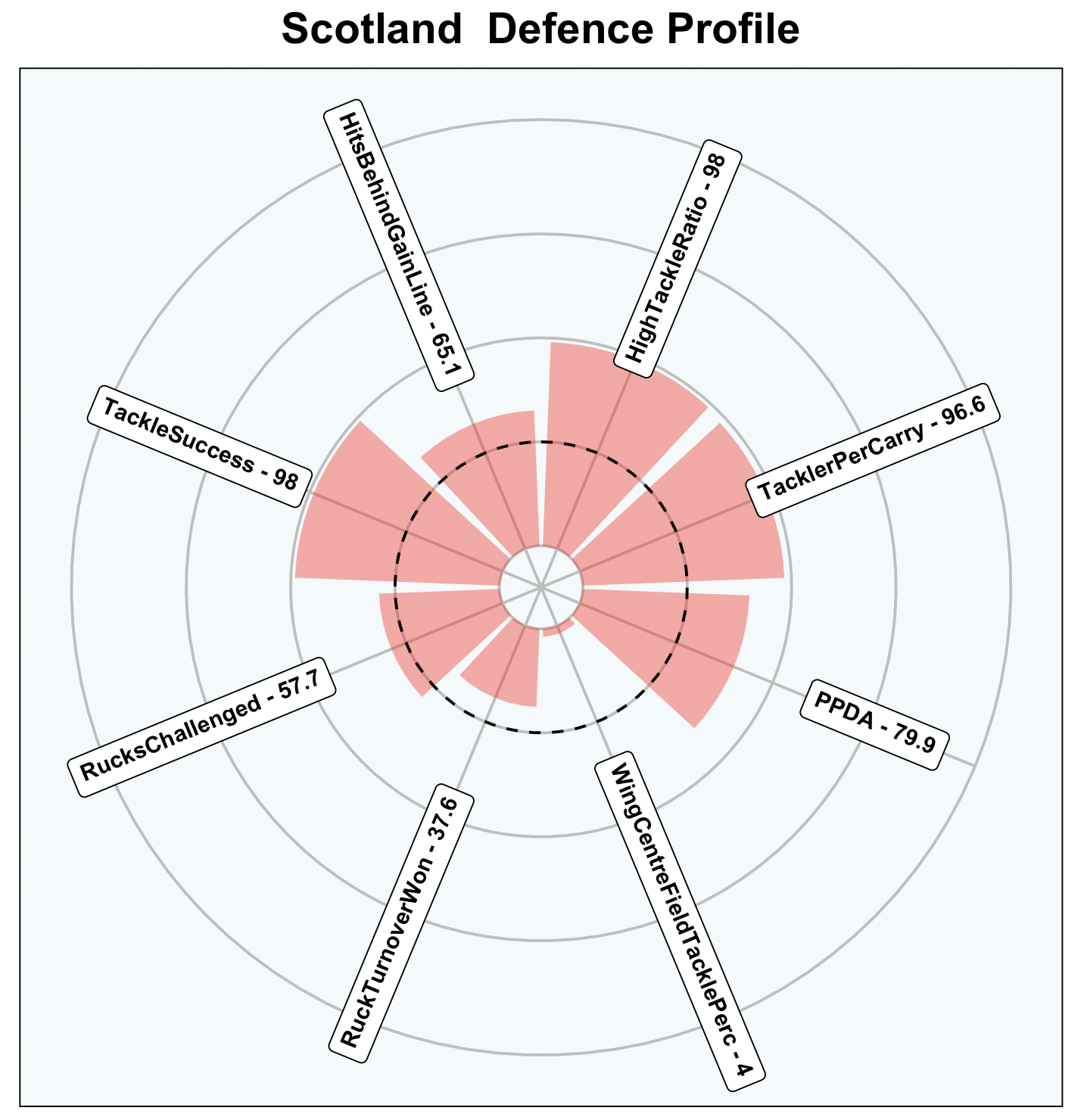
The defence radar gives a good indication of how Scotland defends, with some very clear focus points. Firstly they prefer to tackle higher, and also load the contact area with multiple players. This is shown by having both being in the top 5% for both tacklers committed per carry and high tackle ratio.
As shown in their game versus Australia, Scotland use the double tackle to target the ball and stop momentum of opposition carriers. By wrapping up the ball in the tackle the Scottish players looked to slow the ball down for following phases. The result is the Scots facing the 4th slowest attacking rucks (filtered to between halfway and defensive 5m) on average.
What the GIF above shows alongside their double tackle system is their desire to get off the line, with the Scots sitting just outside the top 20% for Passes per defensive action across professional rugby. This shows Steve Tandy’s intent to try to apply pressure with the Scotland defence, however the method used by Scotland is also interesting.
In rugby two trains of thought have developed within defence around how to apply pressure, Blitz v Drift. Sides can be grouped by whether they drift: absorbing pressure and allowing the attack to work towards the touchline. Or whether they Blitz: pincering from the outside and using an aggressive press to force the attack back towards the ruck.
The clip below shows Scotland’s drift defence in full effect. Australia are allowed to make multiple passes and Scotland just drift across with the ball before making the tackle in the wide area having lost a couple of metres but remained connected.
As described in this Rugby World Piece ( The evolution of Lions defence coach Steve Tandy – Rugby World ), Tandy has set about building a great Zonal defence away from the need for individual reads the Scotland team is asked to tackle. This defensive system helps minimise errors, Scotland have the best tackle success rate across professional rugby (of teams with 10 games played) at 91.2%. The system’s preference for connection over aggression is one of the reasons they have developed such a difficult defence to break down over recent years.
The screenshot below shows how Scotland go about building their zonal defence, the first cornerstone is the width of the defensive line. The winger is sat firmly in the 15m while the rest of the defence is packed tighter, this will allow them to remain compact and connected as England play the ball.
The second key aspect for the Scottish defence is enabled by this width. The Scotland 13 is able to set up outside the opposition forward pod which will allow him to assist in the double tackle if England hit a short runner. His width also allows him to swim around the block if England play wider and assist with the tackle in the wide channel.

As you can see in the clip below Scotland are able to drift as a compact unit and then apply pressure in the breakdown out wide. Note how key 13, Huw Jones, is in this defensive phase swimming past the forward runners to cover the missed tackle and challenge at the ruck. An illegal clear out from England then gives Scotland a penalty.
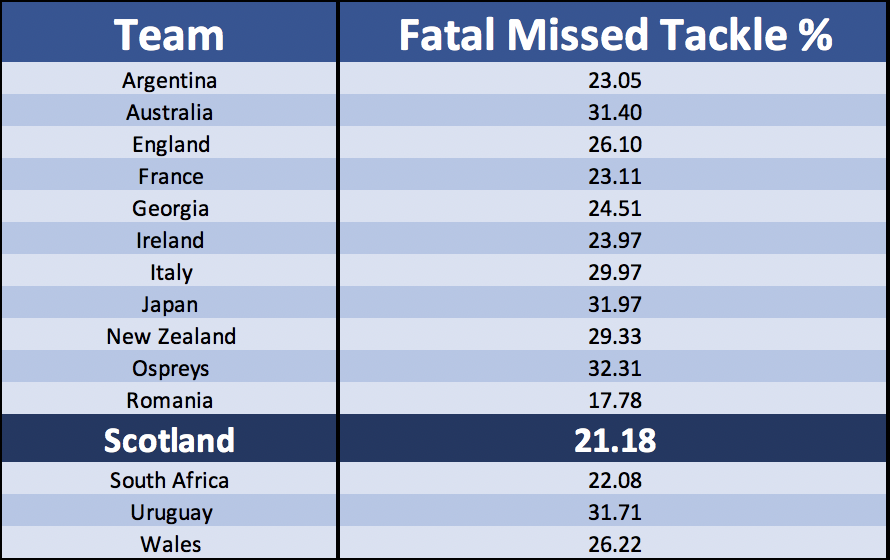
The compactness of the Scotland defence has another benefit as shown in the clip above, missed tackles are rarely significant threats. Scotland (19 Games) have the lowest percentage of missed tackles leading to tries or breaks of anyone bar Romania (6 Games) in International rugby. This fail safe nature in the Scottish defence is by design and allows them to make mistakes without leading to huge opportunities for their opponents.
Townsend’s Attacking Weapons
Scotland have built a great defensive system but they have also matched it with a strong attacking system which allows them to stress teams with ball in hand. They have two weapons in particular we will look at today, in general phase play their use of 3-2 forward pods which help them spread the play. When launching their attacks Gregor Townsend is a big fan of the rewind attack allowing Scotland to punish defences who get their folds wrong.
Escaping From The Edge: The Three Two Set Up
Scotland’s phase play attack is predominantly driven by their Fly Half. To do this they often use a 3-2 (or 3-3) forward pod shape off an edge. This setup gives an option for the 10 to hit forwards up directly off 9 or they can pull it back and challenge using a second wider forward pod. Take a look at this example against England. The initial 3 player forward pod screens Finn Russell who then passes to Pierre Schoeman.
On this occasion the carry isn’t great and Scotland lose a little ground but the width means that England’s fold is under stress. A messy ruck results in the ball spilling out and Ben White takes full advantage to snipe and score.
This phase against Australia shows their intent to spread it wide. A forward pod of three runs hard with Gilchrist pulling the ball back. Kinghorn takes the ball and stops his feet to fire a tunnel pass between the second forward pod and allow Scotland to find the edge.
This shape benefits from its flexibility especially within the second pod of two forwards. The Fly Half for example is able to hit three different players (2 forwards and the back in behind) but is also able to change his run and open up different angles for each of these forward runners. This versatility and adaptability in the attack is a real bonus for Scotland and allows them to show different pictures even if they start from similar positions.
Springing a Surprise – Scotland’s Rewind Attack
Under Gregor Townsend Scotland have become a team who love a rewind attack, frequently hitting into midfield before coming back against the grain to try and expose sides who overfold.
Take for example this try from their game against Italy in the first of the World Cup warm ups. A short pass from Ali Price to Stafford MacDowell who gets over the gain line. Italy’s back row gets off the scrum quickly and fold expecting Scotland to play the same way. Ali Price however has other ideas and snipes against the grain to link with Graham to score.
This score wasn’t an example of an isolated play but instead a theme within the Scottish attack. Against Australia we see Scotland running a 21 Play – 21 meaning two phases in one direction before coming against the grain – this time starting off a lineout.
This first carry from Tuipulotu is strong and gets Scotland on the front foot having broken the gain line. Worth noting how good Hamish Watson’s delivery is from the maul, with the openside flanker fixing the tail gunner before giving the pass meaning that Tuipulotu takes the ball on the gain line.
The second phase is around the corner, note the width on the Scottish forward pod dragging play to the outside post. This drags the Australian defence across the field as well as opening both sides of the field for the next phase.
Coming off that outside post ruck, Scotland hit back against the grain with Ali Price firing a pass to Sione Tuipolutu who has formed a 3 man pod. The outside option of Matt Fagerson helps attract the fifth Australian defenders. The defender biting in allows Kinghorn to time the ball before freeing Full Back Ollie Smith who scores a great try.
Scotland’s rewind could be a great weapon at the World Cup as they look to expose overzealous defences. Mixing up their attack and surprising the opposition will be key if they are to spring an upset. This kick off the back of a 21 play against Ireland shows how they can also be used to manipulate the back field and apply pressure with the boot.
Scotland Pool B King Makers?
Scotland have been dealt a hard hand with Ireland and South Africa in their pool. However its not impossible to see them springing a surprise. Scotland have become a team who are always a threat on any given day and while they may lack consistency all it takes is one shock win and they could find themselves in the World Cup knockout stages. If they are to spring an upset then Steve Tandy’s zonal defence system will be key, minimising the damage from mistakes while proving more than capable of absorbing pressure. Coupled with an attack with the capability to hit both sides of the breakdown and with one of the world’s inform centre partnerships Scotland will be an exciting watch regardless of the result this autumn.


 The Analysis Guy
That’s not Ali Price sniping and scoring – it’s Ben White.
LikeLike
Cheers Tom, have fixed now.
LikeLike