
The lineout is rugby’s holy grail when it comes to attack. This is simply down to the various options teams can use on the attack. Teams have the option to pin various amounts of forwards in the lineout and numbers in their backlines to strike. As we are still in the rugby doldrums, I look back to three examples showing three different scoring moves from three games, with the aim of showing how the world’s best use rugby’s most plentiful platform.
The first lineout is from England v Scotland in 2017. Whilst it turned into a one sided affair with England taking the calcutta cup, Scotland’s simplistic but effective back peel attack is where we will start. The lineout is a 9 + 1 set up. This unusual lineout, involves the Scrum Half, Centre and Winger standing in the lineout, whilst openside Hamish Watson plays as a “+1” scrum half. This setup had been used in a previous game against Ireland leading to a quick lineout try for Dunbar. Therefore, England see the front of the lineout as a major threat, with 2 key jumpers Launchbury and Itoje focussed at the front of the lineout. This means there is no challenge at the back.

The tail ball also allows another element of England’s defence to be exposed. As England have selected 2 playmakers in Ford and Farrell this leaves two supposedly “weaker” tacklers at the hinge of the lineout. This hinge can then be further exposed when we look at the peel Scotland execute.

The screenshot below of the key moment shows how Scotland wrap Dunbar around attacking the two playmaker axis and allow Scotland to go over the gainline.

Dylan Hartley, the England hooker, sits behind the lineout and commits to the maul. This means that the English defence don’t have a player wrapping to fill the orange area between the tail of the lineout and the advancing backs. Had Hartley remained disengaged it would have allowed a double tackle on Dunbar and the ball could have been slowed. Instead Dunbar is allowed to make a strong carry directly at Ford and crucially gets on the fly half’s outside.

As Dunbar makes his carry, Scotland wrap round with the two Gray brothers instrumental in creating holes. At the first ruck Richie wearing 4 goes beyond and slows the folding Joe Launchbury. Then, brother Jonny lifts the ball to Fraser Brown who bulldozes past Haskell and works hard on the floor to gain another meter. Richie’s action in holding Launchbury means he can’t make a positive action, and instead sprawls in front of Brown to stop the try.
Scotland have also swarmed the rucks on both occasions allowing plenty of time for recovery from the wrap and allowing them to “beat the fold”. By getting more numbers beyond the ruck it keeps generating quick balls and stops any positive defensive actions. You’ll notice that Johnathon Joseph is the only one that presses from England.

At this ruck, yet again the Gray brothers play an important role. Richie, number 4, sits at the back and screens Gordon Reid at the base of the ruck. However, the hole Reid exploits is opened by Jonny Gray. Jonny Gray blocks off the fold while sweeping Lawes away from the ruck. This leaves Ben Youngs defending at guard without a support tackler. This allows Reid to batter over and Scotland score. Gray’s effect is seen more significantly from the rear angle.

Gray can be seen reaching out to grab out Hartley. This prevents a final defender helping to repel Reid. Haskell drives from the side having only just returned from the Scottish side of the breakdown. This side force on Reid drives him towards the hole. The Scottish prop is low and uses his knees to create a second driving force to power over.
The first try is an example of simplicity in action. By using an unusual set up, it means England immediately relates it to Dunbars’ previous try. This opens the space, and allows Scotland to target England’s weaknesses. The speed at which they fold, allows them to pick their lines. The simple move opens the whole England defence and allows two carries, at weaker tacklers in George Ford from the peel, to Ben Youngs for the try scoring carry.
The second try we look back at Gatland’s second grand slam and a Johnathon Davies try in the Wales game v Ireland in 2012. The move is a one phase wonder where Wales strike using George North before a wonderful offload frees Davies.

Wales attack from a simple 7 man lineout with Adam Jones, Justin Tipuric, and Faletau in the back pod. This tail ball is risky and Ireland have a small pod which challenges but they are unable to stop the ball or influence the play in a meaningful way. The movement of number 5, Ian Evans, towards the front of the lineout drags slight attention of Paul O’Connell to the front. This prevents an effective scramble and slows the irish supporting filling in as Tipuric, then backs into the irish defence.
Once Tipuric has caught the ball,he lays it off to Mike Phillips. Ireland in defence have used Rory Best as tail defence. This means he is pushing across from the end of the lineout, while Ireland’s scrum half, Connor Murray, hovers at the front. This setup means that Mike Phillips is beyond Best and able to target Tommy Bowe who is defending the hinge of the Lineout. This enables Priestland to attack the Irish centre partnership. The movement of Philips from the front and attacking round the tail of the Lineout gives extra speed to the Welsh attack and aims to keep Ireland’s defence on the back foot.

In the screenshot above, Wales have a simple 2 option play off the Fly Half. Ireland have a tight 3 man press, red line, with a slight gap between the centre partnership of D’Arcy and McFadden. With the screen line from Roberts it creates a focus point for the Irish defence. This creates a gap which Priestland can use North to exploit.

This disconnect becomes even clearer as North receives the ball. Roberts has acted as a screen and has dragged in D’Arcy. However McFadden circled in red has pushed too far forward this creates the space North needs to break the Irish line. The Irish disconnect is now exposed as North gets the ball. Johnathon Davies is hovering as the second welsh player from the touchline with significant depth. This allows him to adapt his line as North bounces through the contact.

North manages to beat D’Arcy on the outside as explained above. This forces McFadden to turn in and face the ball. This creates the shattered conditions for Davies to take advantage. North’s carry also draws the attention of Trimble. By creating doubt in the wingers mind, North has forcibly dragged Ireland tighter. North has carried the ball under his outside arm meaning it is protected as he carries. However, once he has dismissed McFadden he can transfer the ball to his hand. This allows a simple break for Davies.
This wonderful try shows 3 key principles of lineout attack.
Firstly, the Welsh attack has lots of moving parts. From the beginning Mike Phillips has faded onto the ball, while fly half Priestland has 2 moving options to use and create space. These multiple options have created the space that North profits from. Jamie Roberts line drags Ireland’s focus and acts as a significant screen for North to make an outside break.
Secondly, the moving parts create doubt in the defence’s mind. For example when North carries he has dragged in Trimble, who sees North smashing through the Irish defence. This doubt allows Wales to think faster and react with a clinical edge that Ireland’s disjointed defence can’t muster.
Thirdly, the welsh handling creates and finishes the opportunity. Priestland slows his feet, as he approaches the Irish defence before flipping a soft pass to North. While Davies holds his depth as North wreaks mayhem within the Irish defence. This allows Davies to change his line and adapt to Norths running. He is also able to burst past the remaining Irish defence before finishing a wonderfully worked try.
The final lineout try is one at the pinnacle of the game. By looking back at the crucial New Zealand try in the Rugby World Cup 2011 final, we see the importance of Lineout pod interaction and how reacting faster than the opposition can result in simple looking tries.
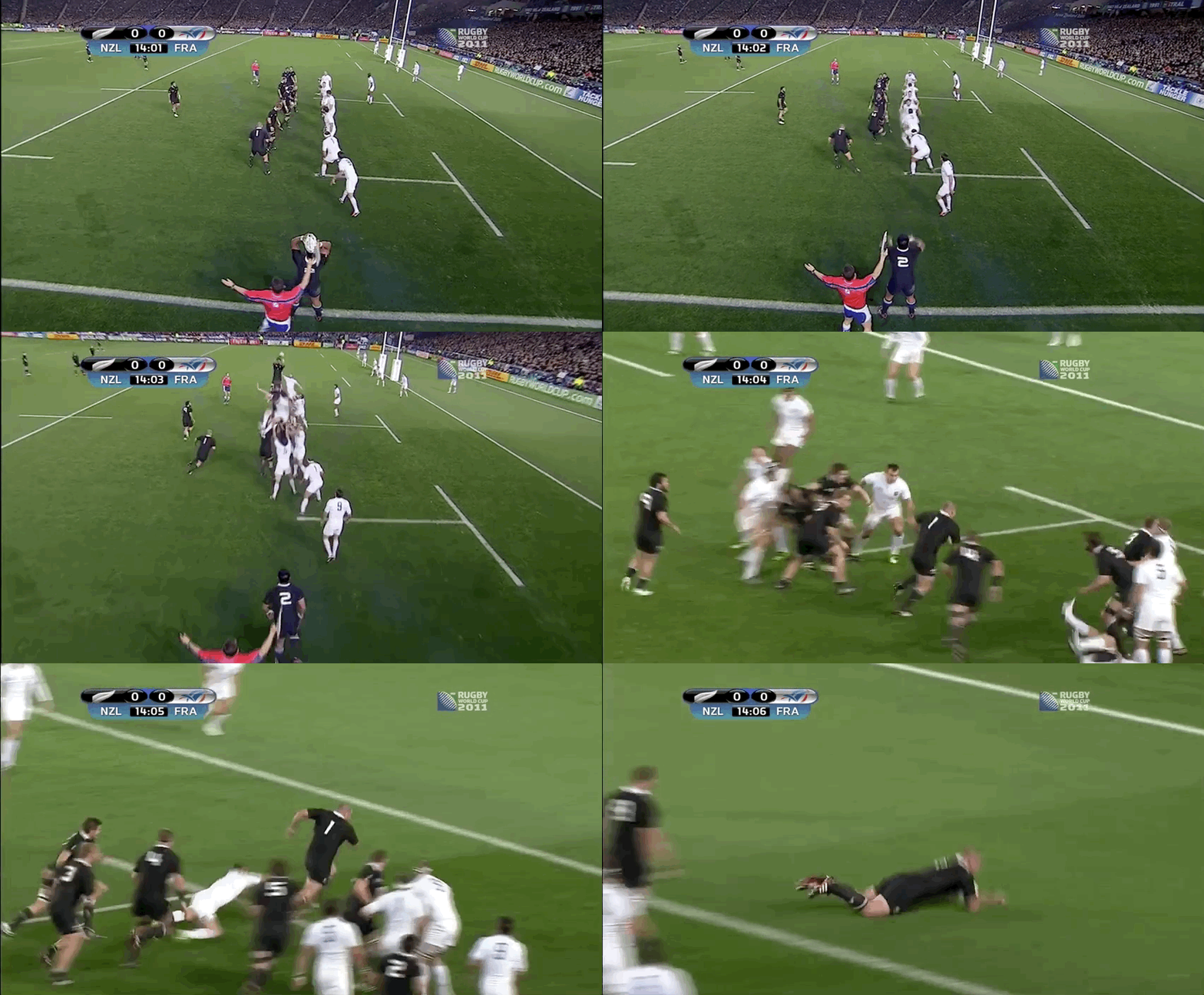
This try comes from a simple exploitation of natural weakness. New Zealand have called a 7 man lineout with loosehead, Woodcock acting as the front marker. This leaves a simple two lifting pod structure. The front pod contains New Zealand’s 4, 5 and 8. The pod moves forward to open the hole. This causes their French counterparts to try challenging further ahead of the ball. This means New Zealand are able to act as physical blockers. This stops France reacting and getting close enough to stop Woodcock scoring.
While the front pod plays a crucial role in preventing the French reacting, the back pod instead acts as the target. It also plays the important role in creating a picture. France defended with the Dusatoir, openside flanker operating as a tail gunner. This means he is aiming to shut off the backline move and act as protection for the French fly half. As soon as the ball is thrown in, Dusatoir reflects Weepu, the All Blacks scrum half. As weepu moves on an outward line, it drags Dusatoir outside the lineout and away from the hole Woodcock attacks.
This movement of Dusatoir, would normally be covered by the french Number 8 acting as the joint within the lineout. However New Zealand 8 steps across having executed his dummy lift. This prevents the natural drag of the French lineout and maintains the hole through which Woodcock can run through.
This try then shows the beauty of exploiting an opposition set up. With Dusatoir being used as a tail gunner, rather than in a traditional covering role it allows New Zealand to strike through the split. It also shows the importance of execution. Woodcock moves early, and crucially beats his opposite number. Then having beaten the French loosehead, Woodcock is able to accelerate onto the ball while also changing his line to beat the sprawling French hooker.
In the three examples above we see there are many ways to see rugby’s most plentiful platform. In the first, we saw a simple back loop that relied on speed and deliberate action to “beat the fold”. This created the opportunity by preventing any meaningful defensive action. In the second we saw how doubt can be easily created and how multiple moving parts create scoring opportunities. The execution of a screen line is important in causing doubt, while the strong carry on the loop shattered the defence. The third try, may seem simplistic in execution but it shows how important manipulation is. By dragging Dusatoir out, and playing off natural movement New Zealand were able to attack a self created hole. The blocking which created the hole is simple, but key in creating and protecting the opportunity.
 The Analysis Guy
Leave a comment